

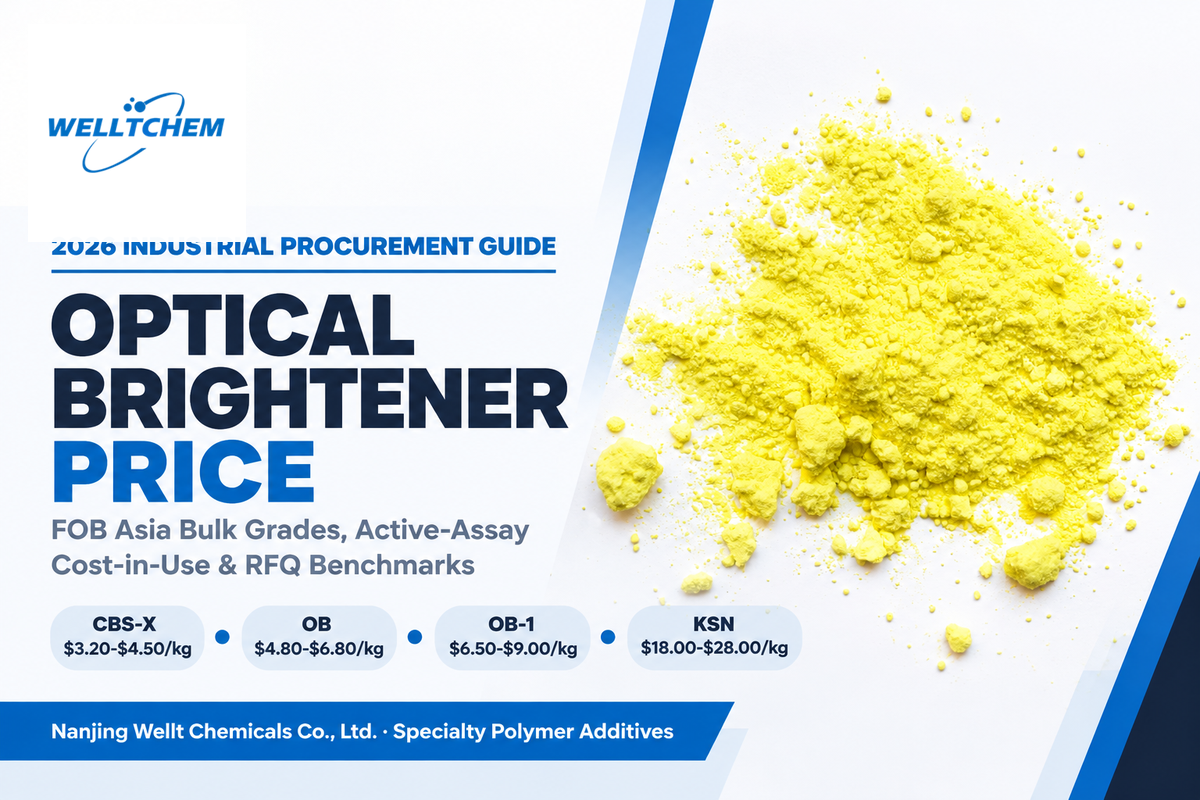
Industrial optical brightener price indications in 2026 start at $3.20 to $4.50/kg FOB Asia for laundry-grade CBS-X per public January 2026 Asian wholesale guides. In that same FOB Asia reference, plastic-grade OB-1 sits at $6.50 to $9.00/kg, OB runs $4.80 to $6.80/kg, and KSN reaches $18.00 to $28.00/kg, while small-MOQ B2B portal listings post higher asking bands. Small retail craft packs carry steep per-kilogram premiums over industrial drums. Smart buyers benchmark active-assay cost-in-use per metric ton of resin, detergent, or paper instead of headline USD/kg.
How Much Does Optical Brightener Cost per Kilogram in 2026?
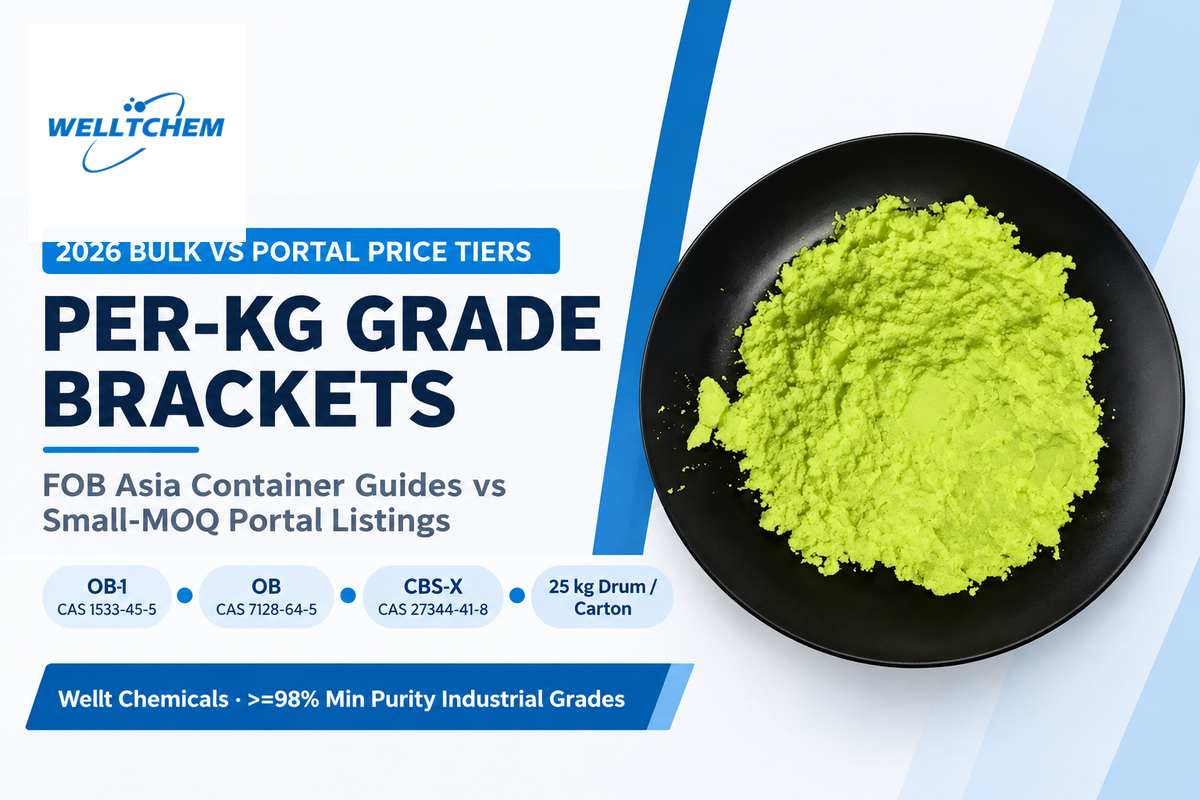
Wholesale industrial optical brighteners span four price brackets in 2026 across public FOB Asia guides and B2B export marketplaces. Laundry-grade CBS-X starts at $3.20/kg FOB, while high-heat KSN reaches $28.00/kg FOB and specialty KSB asks $48.00 to $50.00/kg on portals. Check grades by actual chemical family and order tier, so procurement budgets can be set in stone.
Public marketplace asking prices diverge from bulk contract rates because portals mix sample lots, diluted blends, and full-pallet bids. In November 2026 B2B portal checks on Made-in-China, OB-1 (CAS 1533-45-5) asking listings span $9.16 to $20.00/kg for 25 kg to 100 kg trial minimums. By contrast, public 2026 FOB Asia bulk guides post lower container-scale estimates: $6.50 to $9.00/kg for OB-1, $4.80 to $6.80/kg for OB, and $7.50 to $10.50/kg for KCB. That same guide lists $18.00 to $28.00/kg for KSN, $3.20 to $4.50/kg for CBS-X, and $5.50 to $8.00/kg for FP-127. Historical Indian import records on Zauba show Optical Brightener OB arriving in standard export drums at a $16.56/kg average declared value. Single-seller TradeIndia portal listings post asking rates up to $59.50/kg for OB and $41.40/kg for KCB.
Reviewing our industrial optical brightener grades and optical brightener OB-1 specifications helps buyers separate neat industrial powder (≥98% minimum purity in standard 25 kg cartons or fiber drums) from consumer hobby bottles. Online retail fabric pouches and specialty resin bottles sell at multiples of bulk factory rates per kilogram. Integrating retail costs into a commercial bill of materials crumples plant budgets.
| Model / Grade | CAS / C.I. No. | Chemical Family | Melting Point / Form | Typical Dosage | 2026 Public Price Range | Source & Commercial Scope |
|---|---|---|---|---|---|---|
| OB-1 (e.g., Wellnox OB-1) | 1533-45-5 / C.I. 393 | Bis-benzoxazole | 353–359 °C; light yellow powder / granule | 0.01%–0.05% (Wellt TDS) | $6.50–$9.00/kg (FOB guide); $9.16–$20.00/kg (B2B portals) | 2026 FOB Asia guide; Made-in-China portal listings |
| OB (e.g., Wellnox OB) | 7128-64-5 / C.I. 184 | Thiophene benzoxazole | 198–203 °C (Wellt TDS); yellow powder | 0.01%–0.05% (Wellt TDS) | $4.80–$6.80/kg (FOB guide); $16.56/kg (India import avg) | 2026 FOB Asia guide; historical Zauba India drum import avg |
| CBS-X | 27344-41-8 / C.I. 351 | Distyrylbiphenyl disulfonate | Water-soluble yellow-green powder / granule | 0.05%–0.30% (CBS-X bulk guide) | $3.20–$4.50/kg (FOB Asia guide) | Public 2026 FOB Asia bulk reference |
| KCB | 5089-22-5 / C.I. 367 | Naphthoxazole | Yellowish-green polymer powder | Low polymer ppm range (EVA/PVC/PE) | $7.50–$10.50/kg (FOB guide); $2.00–$20.00/kg (B2B portal) | 2026 FOB Asia guide; Made-in-China portal listings |
| FP-127 | 40470-68-6 / C.I. 378 | Bis-styryl biphenyl | Pale yellow polymer powder | Low polymer ppm range (PVC/PS/ABS) | $5.50–$8.00/kg (FOB guide); $10,000–$15,000/ton (B2B portal) | 2026 FOB Asia guide; Made-in-China portal listing |
| KSN | 5242-49-9 / C.I. 368 | High-heat benzoxazole | Yellow crystalline high-heat powder | Low polymer ppm range (engineering plastics) | $18.00–$28.00/kg (FOB guide); $17.50–$40.00/kg (B2B portal) | 2026 FOB Asia guide; Made-in-China portal listings |
| KSB | 5242-49-9 (isomer) / C.I. 368 | High-weathering benzoxazole | Fine high-heat polymer powder | Low polymer ppm range (film/fibers) | $48.00–$50.00/kg (B2B portal asking) | Made-in-China specialty export portal listings |
| SWN / MDAC | 91-44-1 / C.I. 140 | Coumarin derivative | Low-melt solvent-soluble powder | Solvent bath / ink formulation level | $20.00–$50.00/kg (B2B portal asking) | Made-in-China specialty solvent portal listings |
| VBL / CXT | 12224-16-7 / C.I. 85 | Triazinylaminostilbene | Water-soluble anionic powder | Pulp & cotton exhaust bath level | Quoted by active strength & salt cut (RFQ) | Commodity paper/textile tier; sold by active strength |
| BBU / BA-L | 16470-24-9 / C.I. 220 | Tetrasulfonated stilbene | Water-soluble powder or liquid | Paper mill wet-end / size press level | Quoted by liquid solids % & drum/IBC (RFQ) | Paper mill bulk liquid/powder; contract pricing |
What Are Examples of Industrial Optical Brighteners and Their Typical Price Tiers?
Across 2026 FOB supplier guides and B2B marketplace asking listings, industrial optical brighteners split into three chemical groups. Plastic-grade OB-1 runs $6.50 to $9.00/kg FOB (up to $20.00/kg on portals), and OB runs $4.80 to $6.80/kg FOB ($16.56/kg India import average). Detergent CBS-X lists at $3.20 to $4.50/kg FOB, while specialty SWN asks $20.00 to $50.00/kg on portals. Bis-benzoxazoles serve plastics and fibers, distyrylbiphenyls serve laundry detergents, and sulfonated stilbenes like VBL and BBU serve paper mills.
Each chemical family matches a distinct thermal and solubility window. High-heat PET extrusion destroys a water-soluble detergent brightener immediately. On the other hand, the nonpolar OB-1 isn’t water soluble in a cold laundry wash.
Always lock in the specific CAS registry number before comparing two wholesale optical brightener price sheets.
What Drives Optical Brightener Prices Across Grades and Regions?
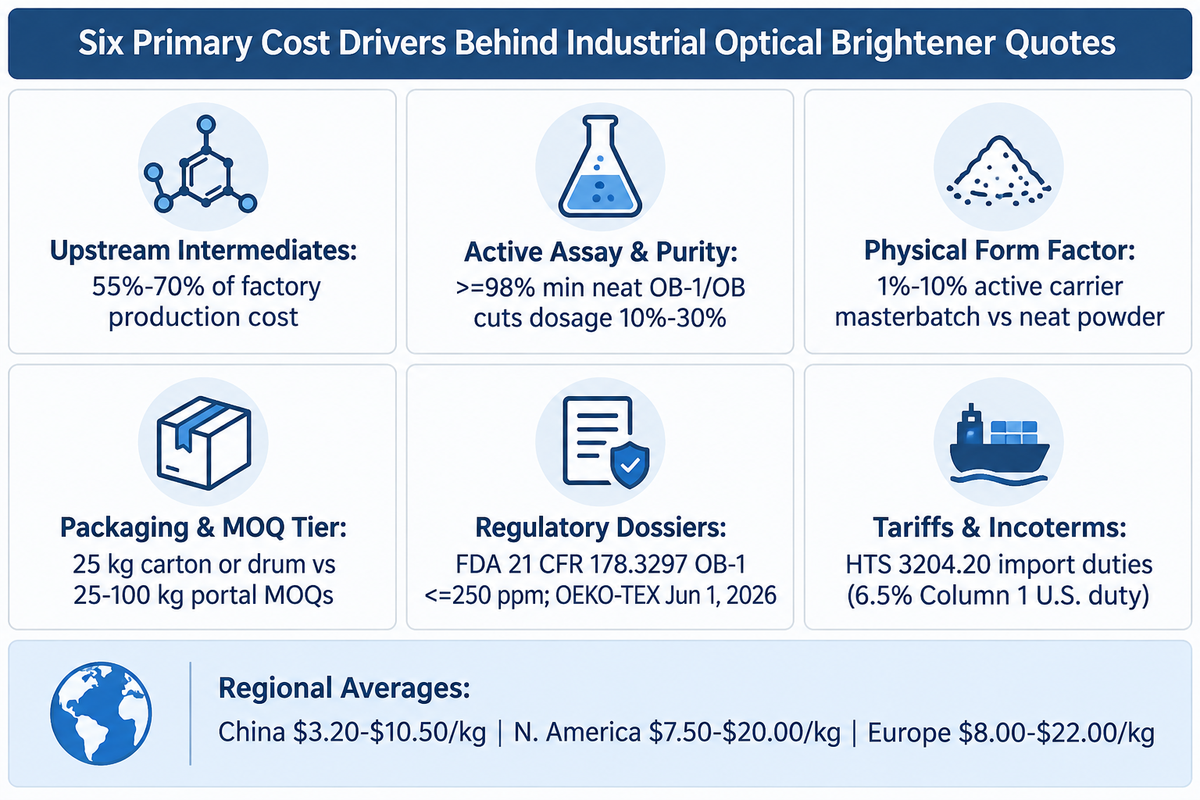
Active purity, physical form, order quantity, and export compliance dossiers drive the remaining spread. Raw chemical intermediates make up 55% to 70% of factory optical brightener production cost per public 2026 supplier breakdowns. Transition from commodity stilbenes to high temperature resistant benzoxazoles raises losses from multi-step syntheses and market price gaps among China, Europe and North America.
Synthesis complexity sets the cost floor for every brightening agent. Commodity paper and detergent grades rely on high-volume DSD acid and sodium salts made in continuous Asian reactors. High-melting plastic grades like KSN and OB-1 (353 to 359 °C melt point) require multi-step condensation and recrystallization. Our OB-1 technical processing profile explains why high-purity plastic synthesis sits well above detergent powder costs. Regional logistics and regulation add another spread: public early-2026 regional comparisons place China wholesale averages at $3.20 to $10.50/kg versus $7.50 to $20.00/kg in North America and $8.00 to $22.00/kg in Europe.
Export compliance adds a major structural cost layer in 2026. U.S. food-contact polymer converters must meet U.S. FDA 21 CFR 178.3297 ceilings. That rule caps OB-1 (CAS 1533-45-5) at 0.025% by weight (250 ppm) up to 275 °F, and caps OB (CAS 7128-64-5) at 0.015% general use or 0.05% in specified food categories. Export mills also budget for EU REACH registration, ISO certification, free formaldehyde and free bisphenol declarations, and updated OEKO-TEX 2026 regulations for STANDARD 100 and ECO PASSPORT effective June 1, 2026.
| Cost Driver | Technical Mechanism | Verified Spec / Cost Benchmark | Procurement Impact |
|---|---|---|---|
| Upstream Intermediates | Feedstock swings in aromatic intermediates and synthesis solvents | 55%–70% of factory production cost (2026 Asian bulk guide) | Drives short quote validity windows across quarters |
| Active Assay & Purity | Recrystallization removes dark byproducts and inorganic fillers | ≥98% min neat OB-1/OB (Wellt TDS) vs diluted commercial cuts | High-purity cuts required dosage by 10%–30% (bulk supplier guide) |
| Physical Form Factor | Standard powder vs dust-free granule vs carrier masterbatch | 1%–10% active carrier masterbatch (EP1709220B1) vs neat powder | Lower $/kg on masterbatch hides higher cost per active kg |
| Packaging & MOQ Tier | Standard 25 kg drum / carton vs palletized FCL shipments | 25 kg carton or drum (Wellt TDS); 25–100 kg portal MOQs | LCL air/sea freight dominates total landed cost on small trials |
| Regulatory Dossiers | REACH registration, FDA 21 CFR 178.3297, OEKO-TEX ECO PASSPORT | OB-1 ≤250 ppm / OB ≤150–500 ppm FDA limits; Jun 1, 2026 OEKO-TEX update | Compliant lots command premiums over unregistered domestic stock |
| Tariffs & Incoterms | HTS 3204.20 import duties, marine insurance, and destination haulage | 6.5% Column 1 general U.S. duty (HTS 3204.20.10.00, excluding surcharges) | FOB China quotes cannot be compared directly to DDP EU/US bids |
How Is Optical Brightener Price Determined by Active Assay and Raw Material Costs?
Factories price an optical brightener agent from two anchored layers: upstream intermediates (55% to 70% of manufacturing cost) and active fluorescence strength verified by HPLC purity and UV E1%1cm extinction values. Cutting full-assay powder with sodium sulfate lowers the invoice price per kilogram. However, it forces plants to double dosage and pay freight on inert salt.
Dust-free granular OB-1 adds a granulation step that cuts airborne dust on automated feeders. Pre-dispersed masterbatch carries a lower invoice price per kilogram because carrier resin (such as LDPE, PP, or nylon 6) makes up 90% to 99% of pellet weight (per EP1709220B1’s 1% to 10% active masterbatch range). Always convert masterbatch quotes to cost per active kilogram.
Costs Beyond the Purchase Price: Dosage Economics, Hidden Scrap Risks, and 5-Year TCO
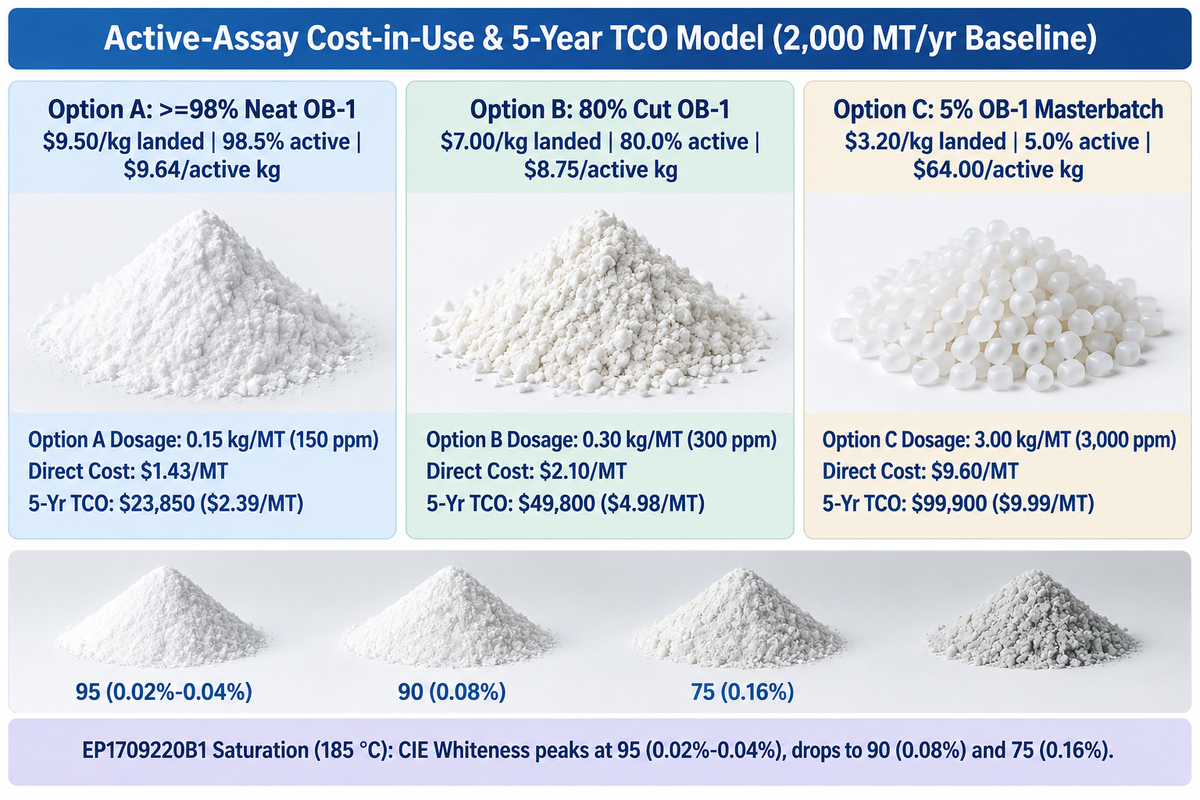
Effective optical brightener spend runs $1.20 to $2.10 per metric ton of finished product in public FOB dosage comparisons at 0.15 to 0.30 kg/ton loading. Cost of cheaper diluted powder raises per-ton additive spend and full-batch scrap risk from yellowing, blooming or UV quenching. Model five-year total cost including landed duty, effective dosage, and scrap.
Use the Active-Assay Cost-in-Use Formula (ACIU) to compare bids fairly. Take the landed price per kilogram, including freight and the USITC HTS 3204.20.10.00 6.5% general U.S. duty (before origin surcharges). Divide that figure by decimal active purity, then multiply by required kilograms of active ingredient per metric ton of finished product. Public FOB dosage comparisons illustrate the gap: high-grade powder at 0.15 kg/ton (150 ppm) costs $1.20/ton, mid-grade at 0.22 kg/ton costs $1.65/ton, and low-grade needing 0.30 kg/ton (300 ppm) costs $2.10/ton.
Worked Example (Assumed Inputs): Suppose a rigid PVC and PET compounder processes 2,000 metric tons of resin yearly. Option A buys neat high-assay OB-1 powder (98.5% active) at $9.50/kg landed and doses 0.015% (0.15 kg/ton, or 300 kg/year). Annual additive spend is $2,850 ($1.43/ton). Option B buys an 80% salt-cut powder at $7.00/kg landed and needs 0.030% (0.30 kg/ton, or 600 kg/year) to match whiteness. Annual spend jumps to $4,200 ($2.10/ton), which is 47% higher before any scrap occurs. Option C buys a 5% active OB-1 masterbatch at $3.20/kg landed and doses 0.30% (3.0 kg/ton, or 6,000 kg/year) for a 150 ppm active level, approximately matching Option A. Annual spend hits $19,200 ($9.60/ton) in exchange for dust-free pellet dosing.
5-year total cost of ownership (Assumed inputs: 2,000 MT/yr resin output; landed USD including 6.5% HTS 3204.20.10.00 general duty baseline):
| Cost item | Option A: ≥98% Neat OB-1 ($9.50/kg, 150 ppm) | Option B: 80% Diluted Powder ($7.00/kg, 300 ppm) | Option C: 5% OB-1 Masterbatch ($3.20/kg, 3,000 ppm) |
|---|---|---|---|
| Purchase price (5-yr landed additive) | $14,250 (1,500 kg) | $21,000 (3,000 kg) | $96,000 (30,000 kg) |
| Installation & commissioning (feeder / trial) | $4,500 (micro-feeder + drawdown trial) | $4,500 (micro-feeder + rework trials) | $500 (existing gravimetric hopper) |
| Energy (5-yr compounding & purge) | $600 (standard line purge) | $1,800 (extra screen-pack & die purges) | $400 (clean pellet changeover) |
| Maintenance & spares (5-yr QC & filters) | $2,000 (annual COA & UV check) | $4,500 (extra lot assay + screen packs) | $1,500 (incoming pellet color check) |
| Downtime risk (5-yr yellowing / speck scrap) | $2,500 (low dispersion variance) | $18,000 (3 rejected 4-MT resin batches at $1,500/MT) | $1,500 (minimal specking risk) |
Payback example: Switching from Option B ($49,800) to Option A ($23,850) saves $25,950 over five years ($5,190/year). A $4,500 micro-feeder upgrade pays back in 10.4 months ($4,500 ÷ $5,190/yr = 0.87 years). Compared to Option C ($99,900), Option A pays back its $4,000 extra feeder spend in 3.2 months ($4,000 ÷ $15,210/yr).
Overdosing hurts margins even faster than filler dilution. Spectrophotometer tests in European Patent EP1709220B1 (ASTM E313-1996 on heat-set Nylon 6,6) show whiteness reversing past saturation. At 185 °C heat-setting, CIE whiteness peaked at 95 at 0.02% and 0.04% OBA. Raising loading to 0.08% dropped whiteness to 90, and 0.16% plunged it to 75. At 200 °C, whiteness peaked at 70 at 0.04% and fell to 55 at 0.16%. Detergent tests in U.S. Patent US20050054550A1 confirm sharp diminishing returns for CBS-X. Yellowness (b*) fell from 9.50 to 4.09 at 0.05%, yet an eightfold jump to 0.40% only reached 1.86 and 0.80% reached 1.02.
Co-additive clashes also waste whitening budgets. Per SpecialChem’s polymer fluorescent whitening agent guide, benzotriazole or triazine UV absorbers for polymer stabilization absorb the same 300 to 400 nm UV light that brighteners need. Dosing extra OBA to fight a UV absorber pushes resin past its yellowing point. Pairing a modest OBA dose with a thermal stabilizer works far better. In EP1709220B1 Table 3, adding 0.2% antioxidant (IRGANOX B1171) alongside 0.04% OBA lifted CIE whiteness from 95 to 113 at 185 °C and from 71 to 101 at 200 °C. Adding plastic antioxidants to prevent thermal yellowing with a stabilizer or nucleating agent preserves base resin color before fluorescence starts.
| Cost & Risk Line Item | Option A: ≥98% Neat OB-1 | Option B: 80% Cut OB-1 | Option C: 5% OB-1 Masterbatch |
|---|---|---|---|
| Landed unit price (incl. 6.5% HTS 3204.20 duty) | $9.50/kg | $7.00/kg | $3.20/kg |
| Effective active assay | 98.5% | 80.0% | 5.0% |
| True price per active kg | $9.64/active kg | $8.75/active kg | $64.00/active kg |
| Required dosage to hit target CIE whiteness | 0.15 kg/MT (150 ppm) | 0.30 kg/MT (300 ppm) | 3.00 kg/MT (3,000 ppm) |
| Direct additive cost per MT finished resin | $1.43/MT | $2.10/MT | $9.60/MT |
| Annual additive spend (2,000 MT/yr) | $2,850/yr | $4,200/yr | $19,200/yr |
| Annual feeder, purge & QC overhead (amortized) | $1,420/yr | $2,160/yr | $480/yr |
| Expected annual off-spec scrap exposure | $500/yr | $3,600/yr | $300/yr |
| Total 5-Year TCO (10,000 MT cumulative) | $23,850 ($2.39/MT) | $49,800 ($4.98/MT) | $99,900 ($9.99/MT) |
Optical Brightener vs. Titanium Dioxide, Bleach, and Bluing Agents: Cost Compared
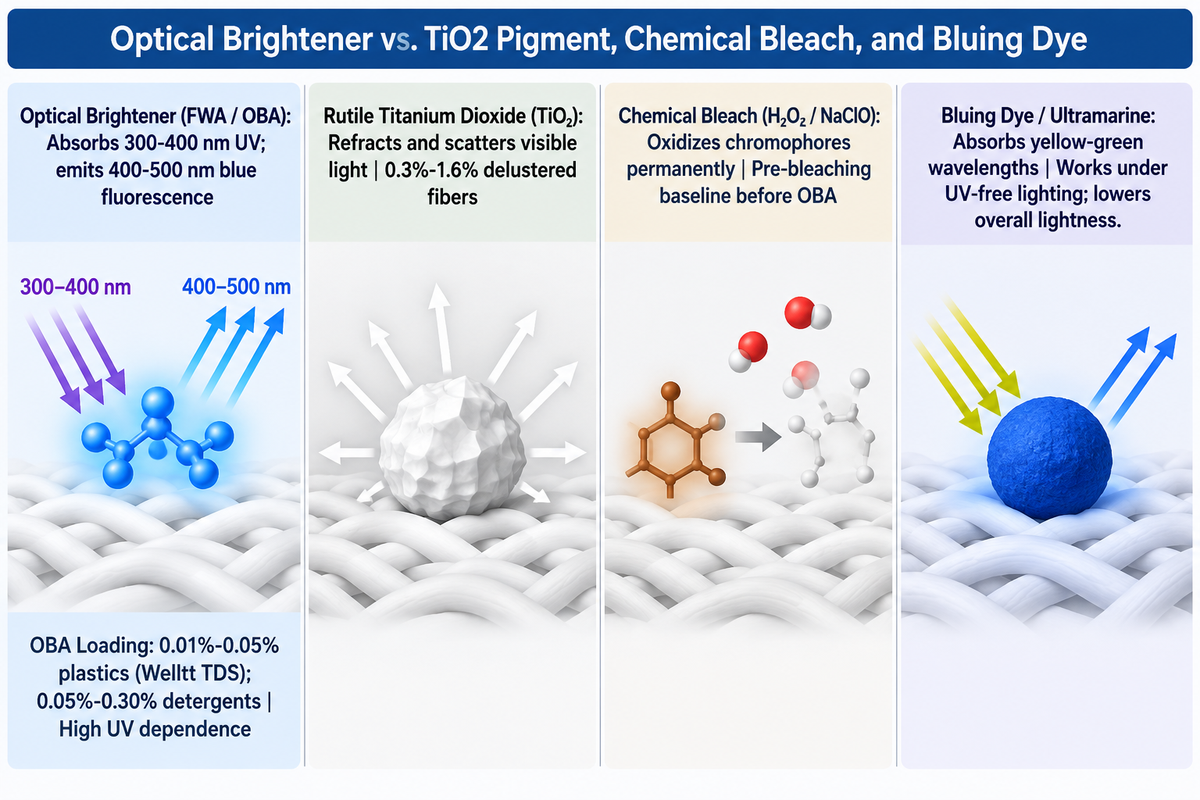
An optical brightener (also called OBA or FBA) works like a miniature light converter. It can take 300 to 400 nm UV and produce 400 to 500 nm blue to mask yellow cast. It makes perceived brightness at 0.01% to 0.05% loading even cheaper than increasing titanium dioxide pigment or bleach cycles.
Under UV-free indoor LEDs, fluorescence stops and pigments or bluing dyes take over.
Photophysics dictates which whitening additive earns its keep. In a 24-sample conservation study by the American Institute for Conservation (Wetzel, 2005), washed papers fluoresced strongly in window daylight due to surface migration. Under UV-filtered gallery lighting, those same optical brighteners became virtually ineffective. SpecialChem reports that titanium dioxide (TiO2) builds opacity by scattering visible light at higher loadings (such as 0.3% to 1.6% in delustered fibers cited in EP1709220B1). However, TiO2 absorbs in the same UV band and lowers FWA whitening output. Our polymer additives selection overview outlines how to balance pigment opacity with fluorescence.
A low dose of OBA combined with conventional TiO2 pigment powder can improve perceived whiteness more than increasing TiO2 loading alone. For an opaque white PVC or PP component, increasing the mass of white pigment adds kilograms of white mineral filler to the resin per ton. Adding 0.02% OB-1 (0.20 kg/ton) restores a crisp blue-white cast at a tiny fraction of that weight whenever end-use light contains UV.
Bluing dyes and organic pigment toners such as ultramarine work without UV light.
| Whitening System | Optical / Chemical Mechanism | Typical Industrial Loading | UV Light Dependence | Best Economic Role |
|---|---|---|---|---|
| Optical Brightener (FWA / OBA) | Absorbs 300–400 nm UV; emits 400–500 nm blue fluorescence | 0.01%–0.05% (plastics, Wellt TDS); 0.05%–0.30% (detergents) | High (ineffective without UV excitation) | Lowest cost per whiteness point in daylight or standard retail lighting |
| Rutile Titanium Dioxide (TiO2) | Refracts and scatters visible light across full spectrum | Higher pigment loading (0.3%–1.6% delustered fibers; higher in opaque parts) | None (works under UV-free LEDs) | Required for hiding power and opacity; competes with OBA for UV |
| Chemical Bleach (H2O2 / NaClO) | Oxidizes and chemically destroys colored chromophores | Bath-weight oxidative dosing on pulp or fabric | None (permanent chemical removal) | Pre-bleaching baseline before OBA; excessive bleach weakens fiber strength |
| Bluing Dye / Ultramarine | Absorbs yellow-green wavelengths to shift hue toward blue | Trace tinting level in resin or wash bath | None (works indoors and outdoors) | Low-cost hue correction under UV-free lighting; lowers overall lightness |
Is Optical Brightener the Same as Bleach, and Which Costs Less at Industrial Scale?

An optical brightener isn’t bleach. At industrial scale, pre-bleaching followed by a trace OBA top-up can achieve target whiteness more cheaply than adding additional chemical bleach stages. Chemical bleach works by oxidising and breaking down stains or naturally yellow pigments present in the pulp or cotton itself.
An optical brightener is a colorless fluorescent additive which masks residual yellow cast without attacking fiber bonds. First pre-bleaching removes the heavier colour, then a low brightener dose completes the whiteness.
Users on laundry forums like Reddit’s r/laundry point out that budget detergents rely heavily on CBS-X optical brightening to keep white shirts bright while shifting dark or pastel fabrics slightly cooler. Textile mills balance the same trade-off: pre-bleach cotton waxes first, then dose the minimum fluorescent brightener needed for target CIE whiteness.
Why Optical Brightener Powder Quotes Vary Widely Between Suppliers
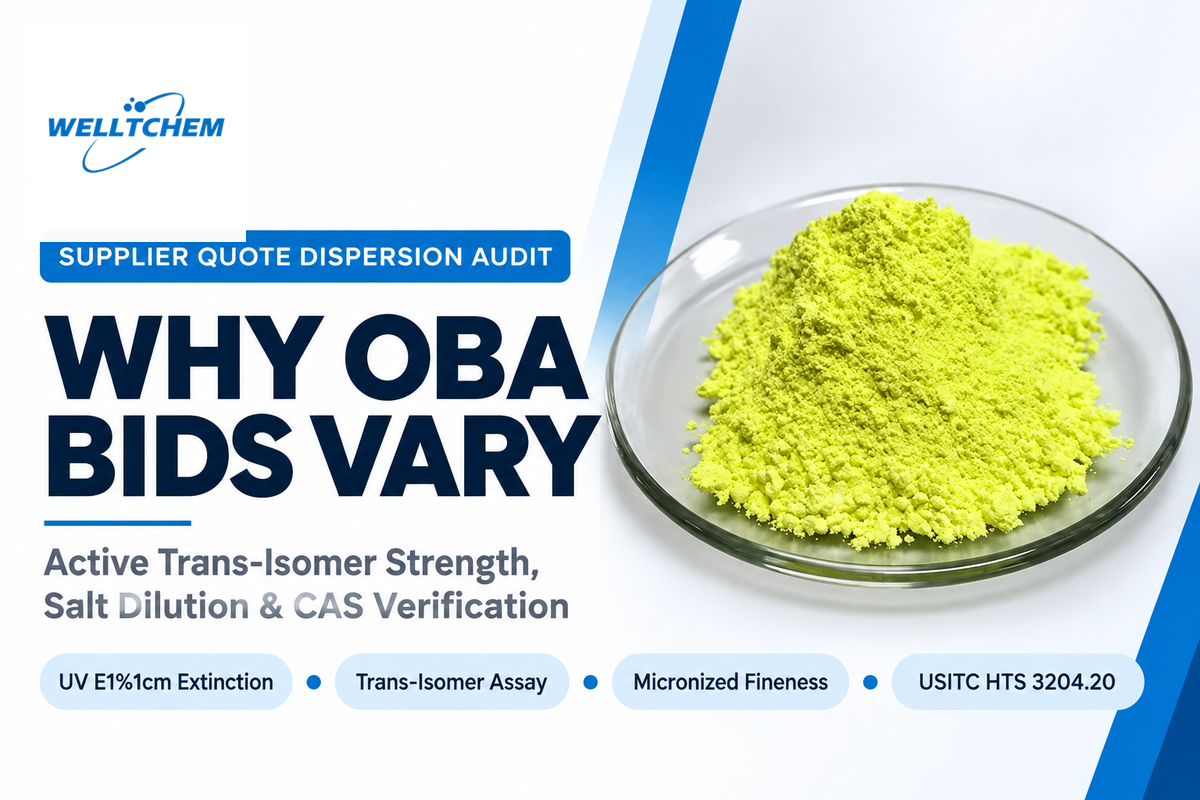
Two quotes for OB-1 or CBS-X powder issued on the same day can differ by multiples.
Public bids hide six technical variables: filler dilution, isomer fluorescence strength, shade bias, milling fineness, channel tier, and Incoterms scope. Quotes sitting well below FOB Asia factory bands typically signal inorganic salt cutting or wrong CAS listings.
B2B portal listings illustrate catalog mistakes. In late-2026 checks on Made-in-China, one marketplace listing posted “Optical Brightener FP-127” at $10,000 to $15,000/ton (1 ton MOQ) while tagging OB-1’s CAS number (1533-45-5) instead of FP-127’s actual CAS (40470-68-6). Another Made-in-China marketplace listing posted a $2.00 to $20.00/kg placeholder asking band for KCB. Comparing raw portal prices without lab specs leads buyers to compare two different chemicals.
- Inorganic salt and wax dilution happens when low-end resellers cut neat yellow-green powder with sodium sulfate or wax to post a low price. Diluted stock drops fluorescence yield and clogs extruder screen packs with ash.
- Trans- versus cis-isomer ratio shifts fluorescence strength sharply because only the active trans-isomer fluoresces efficiently. Two lots claiming similar basic titration purity can still differ in UV extinction strength.
- Change in shade (greenish versus blue-violet) affects purification yield. Recrystallization solvent choice splits OB-1 into greenish-yellow or blue-violet crystal habits, and tight-tolerance blue-violet lots carry higher factory pricing.
- Dispersion cost is dominated by particle size, fineness and solvent resistance. Micronized powder disperses cleanly in thin films and solvent resistant coatings without white specks, while coarser crystals cost less to grind yet streak blow-molded bottles.
- Channel tier distinguishes between direct factories and traders, and legacy multinationals. Cost plus margin to European legacy brands and trading broker mark-up is higher than the cost plus conversion margin of a direct Asian chemical factory.
- Incoterms and shipment-month pass-through separate factory-gate bids from landed quotes. EXW bids don’t include export clearance, drum palletizing, ocean freight, and destination duties (classified under USITC HTS 3204.20.1000 for synthetic fluorescent brightening agents). Normalize each agent supplier bid to a single port and currency.
Common Mistake: Qualifying a supplier on a small lab sample without writing UV E1%1cm extinction, melting range, and max ash into the purchase contract. When a cut-rate vendor switches from high-purity sample stock to diluted commercial drums, plants lose full production batches to off-shade extruded profiles.
How to Match Optical Brightener Grades to Plastics, Detergents, Textiles, and Paper
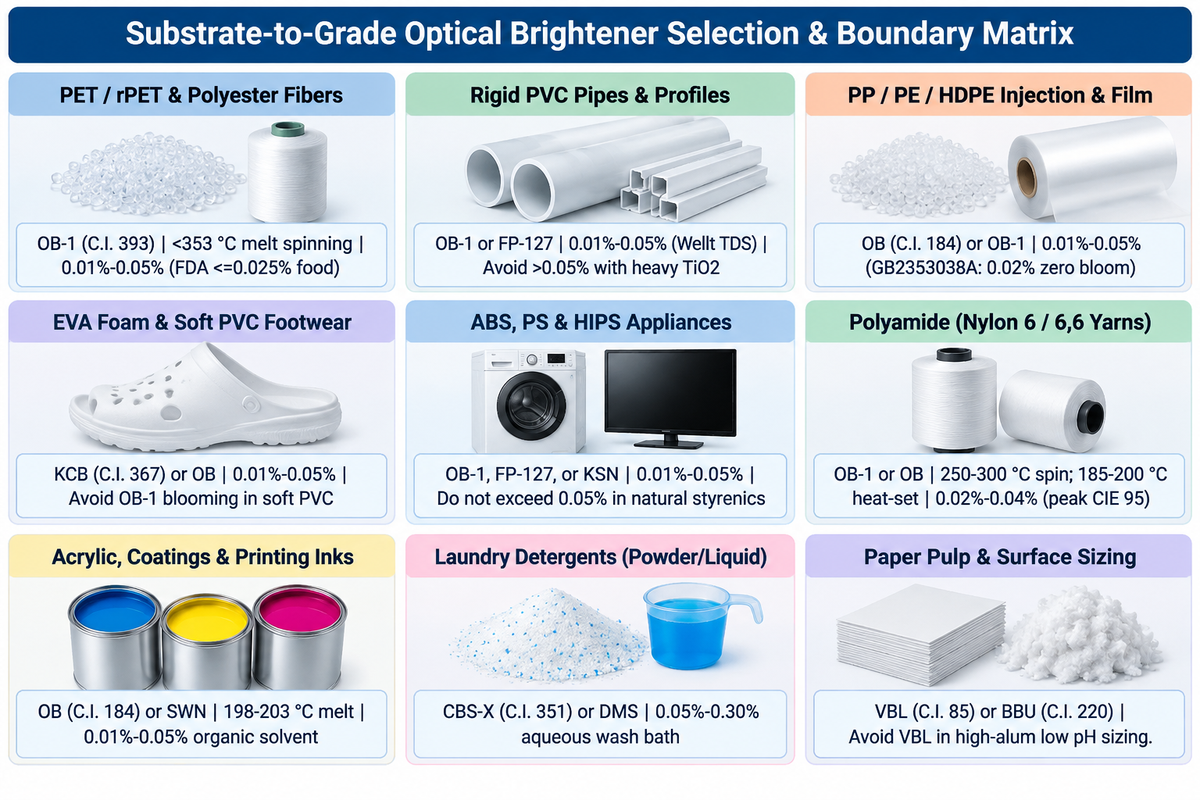
Match each optical brightener strictly to peak processing heat and medium solubility. Pick OB-1 (353 to 359 °C melt) for PET, PA, and engineering plastics, and OB (198 to 203 °C melt) for polyolefins, films, and coatings. Choose KCB or FP-127 for PVC and EVA, and water-soluble CBS-X or stilbenes for detergents and paper. Mismatching melt point or solubility causes barrel burn-off, blooming, or zero brightening.
Comparing our Optical Brightener OB (C.I. 184) grade against OB-1 shows how melt temperature governs selection. Wellt Chemicals’ Wellnox OB melts at 198 to 203 °C at 0.01% to 0.05% dosage and dissolves cleanly in organic solvents. That suits polyolefins (PE, PP), clear films, printing inks, and specialty coating additives. Wellnox OB-1 melts at 353 to 359 °C at the same loading window, surviving high-heat polyester spinning and rPET extrusion where OB volatilizes. In polyolefin film tests, UK Patent GB2353038A achieved zero blooming at 0.02% wt (200 ppm) OB-1 loading.
Recycled polymers (rPET and rHDPE) need dedicated yellowing-point trials because post-consumer regrind carries variable degradation color. Compounders running recycled resin typically start near 0.02% OB-1 (200 ppm) paired with a primary antioxidant. Pushing brightener past 0.05% triggers blue-green reversion instead of cleaner white.
| Target Substrate / Process | Recommended Grade | Thermal / Medium Window | Typical Dosage | Not Recommended / Failure Boundary |
|---|---|---|---|---|
| PET / rPET & Polyester Fibers | OB-1 (C.I. 393) | High-heat melt spinning / extrusion (<353 °C) | 0.01%–0.05% (FDA ≤0.025% food) | Do not use OB (melts 198–203 °C) in PET barrels; volatilizes under high heat |
| Rigid PVC Pipes & Profiles | OB-1 or FP-127 | Rigid PVC twin-screw extrusion | 0.01%–0.05% (Wellt TDS) | Avoid >0.05% in outdoor window profiles with heavy TiO2/UV stabilizer loads |
| PP / PE / HDPE Injection & Film | OB (C.I. 184) or OB-1 | Polyolefin film & injection molding | 0.01%–0.05% (GB2353038A: 0.02% zero bloom) | Do not use water-soluble CBS-X or VBL; incompatible and causes surface haze |
| EVA Foam & Soft PVC Footwear | KCB (C.I. 367) or OB | Foam compounding & calendering | 0.01%–0.05% | Avoid OB-1 in heavily plasticized soft PVC; low solubility drives surface blooming |
| ABS, PS & HIPS Appliances | OB-1, FP-127, or KSN | Styrenic injection molding | 0.01%–0.05% | Do not exceed 0.05% in natural styrenics; triggers greenish hue shift |
| Polyamide (Nylon 6 / 6,6 Yarns) | OB-1 or OB (+ antioxidant) | 250–300 °C spinning; 185–200 °C heat-set (EP1709220B1) | 0.02%–0.04% (EP1709220B1 peak CIE 95) | Do not dose ≥0.08%; EP1709220B1 shows CIE whiteness drops from 95 to 75 at 0.16% |
| Acrylic, Coatings & Printing Inks | OB (C.I. 184) or SWN | Organic solvent / UV-cure coating systems | 0.01%–0.05% (Wellt OB TDS) | Avoid insoluble OB-1 in clear varnishes; settles out and leaves particulate haze |
| Laundry Detergents (Powder/Liquid) | CBS-X (C.I. 351) or DMS | Aqueous wash baths (cold/warm) | 0.05%–0.30% (US20050054550A1 knee at 0.05%) | Do not use water-insoluble OB/OB-1; zero fabric substantivity in wash water |
| Paper Pulp & Surface Sizing | VBL (C.I. 85) or BBU (C.I. 220) | Aqueous wet-end pulp / starch size press | Mill wet-end / surface sizing ratio | Avoid disulfonic VBL in high-alum acid sizing; precipitates under low pH |
What Is Changing in the Optical Brightener Market in 2026: Supply Shifts and Pricing Risks
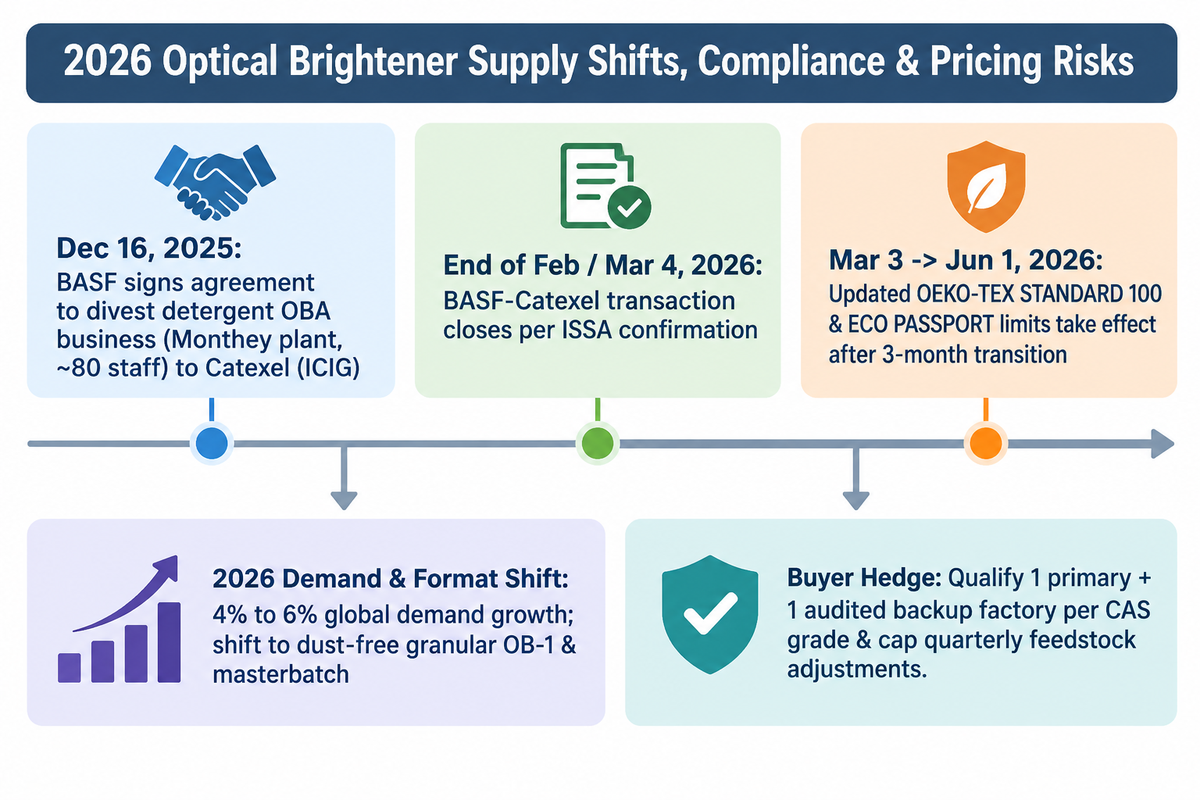
Two confirmed structural shifts are reshaping global optical brightener sourcing in 2026.
First, BASF transferred its detergent optical brightening agent business to Catexel (ICIG) at the end of February 2026.
Second, updated OEKO-TEX STANDARD 100 and ECO PASSPORT chemical rules take effect on June 1, 2026. Single-source buyers now face re-qualification lead times and tighter raw-material pass-through terms.
On December 16, 2025, BASF signed an agreement to divest its laundry detergent OBA business to Catexel, the Care Chemicals platform of International Chemical Investors Group (ICIG). The transfer covered BASF’s Monthey, Switzerland plant and roughly 80 employees. The ISSA Worldwide Cleaning Industry Association (March 4, 2026) confirmed the closing upon completion of the handover.
“As part of our ‘Winning Ways’ strategy, we are actively managing our portfolio and drive prioritization. With Catexel a committed, focused new owner will develop the business further and thereby realize its potential.”
Product formats and export compliance rules are tightening at the same time. Recycled polyester and textile plants are shifting from dusty powders to dust-free granular OB-1 and masterbatch pellets for cleaner dosing. On March 3, 2026, OEKO-TEX released its updated 2026 rules, enforcing revised ECO PASSPORT and STANDARD 100 limits after a three-month transition.
As broader market context, ChemAnalyst noted rising Q3 2026 North American OBA prices on higher production expenses, while public 2026 supplier market overviews cite 4% to 6% average global demand growth. Buyers planning upcoming container contracts should qualify one primary and one audited backup supplier per CAS grade now, cap quarterly feedstock adjustments, and audit 2026 compliance certificates before booking shipments.
How to Get an Accurate Optical Brightener Quote and Qualify Bulk Suppliers
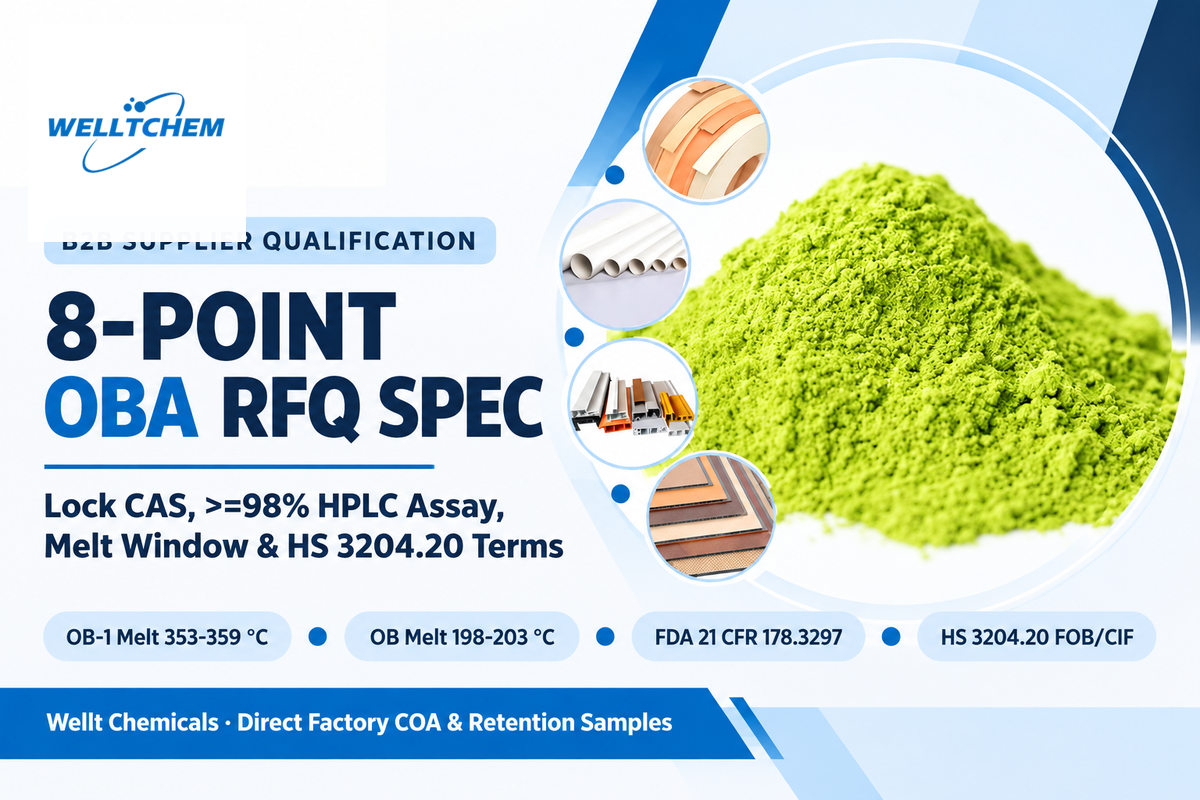
Send every optical brightener manufacturer an 8-item RFQ with exact CAS number, minimum HPLC purity, melting point range, target shade, physical form, order volume in standard export drums or pallets, compliance standard, and destination Incoterms. Vague inquiries like “send OB-1 price” produce placeholder bids that climb sharply once food-contact dossiers, palletization, and freight are added.
Copy the checklist below into your supplier RFQ to receive comparable commercial bids and prevent incoming batch disputes:
RFQ checklist — copy these into your quote request:
| Parameter | Recommended range | Why it matters | How to verify |
|---|---|---|---|
| CAS & C.I. Number | Exact grade (e.g., 1533-45-5 / C.I. 393) | Prevents portal catalog mismatches such as FP-127 tagged as OB-1 | Match CAS on SDS, COA, and commercial invoice |
| Active Assay Purity | ≥98% min neat OB-1 / OB (Wellt TDS) | Eliminates hidden sodium sulfate or wax dilution | Require lot-specific HPLC assay and E1%1cm value |
| Melting Point Range | 353–359 °C (OB-1); 198–203 °C (OB) | Confirms thermal survival inside polymer extruder barrels | Capillary melt test on pre-shipment retention sample |
| Fluorescence Shade & Consistency | Greenish or blue-violet matched to standard | Stops visible shade drift across consecutive production lots | Spectrophotometer CIE L*a*b* drawdown vs master standard |
| Physical Form & Fineness | Micronized powder, dust-free granule, or masterbatch | Controls feeder accuracy, dust safety, and film specking | Check sieve fineness and bulk density on lot COA |
| Packaging & Order Tier | 25 kg fiber drum / carton; palletized or FCL | Unlocks factory volume breaks and protects moisture-sensitive powder | Confirm inner PE liner weight and palletized gross mass |
| Compliance Documentation | FDA 21 CFR 178.3297, REACH, OEKO-TEX 2026 | Prevents customs holds and retail brand audit rejections | Request signed compliance letter and registration number before PO |
| Incoterms & HS Code | FOB / CIF / DDP; HS 3204.20 (confirm 10-digit subheading per CAS) | Makes cross-region landed cost comparisons transparent | Itemize FOB price, ocean freight, insurance, and duty basis |
Which Global and Regional Optical Brightener Manufacturers Fit Bulk Export Compliance?
Global European producers such as Catexel (operating the former BASF Monthey OBA site), Archroma, and Blankophor fit detergent and paper mills requiring European-origin dossiers. Direct Asian specialty manufacturers like Wellt Chemicals (Nanjing Wellt Chemicals Co., Ltd.) supply plastic OB-1 and OB grades for bulk export. They ship high-purity stock in standard export drums backed by lot COAs and export documentation.
Skip anonymous trading brokers on recurring bulk orders, because brokers often swap upstream factories between shipments. When your plant sources polymer additives and needs good quality optical brightener stock for fibers and plastic or coatings, deal directly with a specialty factory. Direct factories supply lot-matched technical datasheets, pre-shipment retention samples, and firm FOB or CIF quotes. Review full grade specs or submit your RFQ through Wellt Chemicals’ optical brightener product hub.
Editorial & Technical Verification Note: Public price benchmarks were compiled in November 2026 from dated B2B export platforms, historical customs averages, and supplier guides; regulatory limits and lab whiteness curves match U.S. eCFR, USITC, OEKO-TEX, and patent filings.
Frequently Asked Questions About Optical Brightener Pricing
How is optical brightener price calculated for bulk export orders and what is the typical MOQ?
Bulk export pricing is based on upstream intermediates (55%-70% of factory cost per public 2026 supplier breakdowns), active purity, physical form, packaging, and Incoterms freight. Trial MOQs begin with one standard 25 kg drum/carton; palletized and full-container quantities benefit from lower factory-direct FOB pricing. U.S. importers will also account for the 6.5% Column 1 general tariff under HTS 3204.20.10.00 and other possible origin surcharges.
What is OBA in manufacturing and how does it impact formulation budgets?
OBA stands for optical brightening agent, an auxiliary agent that adds roughly $1.20 to $2.10 per resin ton in public FOB dosage benchmarks at 0.015% to 0.030% polymer loading. Manufacturers dose it into plastics, fibers, paper pulp, coatings, and detergents. The additive converts invisible near-UV wavelengths into visible blue fluorescence to offset yellowing. Keeping high-quality OBA below the yellowing threshold holds whitening spend minimal.
Why do optical brightener prices increase or fluctuate across quarters?
Quarterly price volatility follows upstream chemical intermediates, which account for more than half of factory costing. Environmental compliance inspections at Asian synthesis parks, plant maintenance turnarounds, and ocean freight spikes also lift spot quotes. Structural shifts like BASF’s early-2026 OBA business handover to Catexel add short-term re-qualification friction.
Qualifying two audited factories per CAS-grade provides directional buyers some degree of quarterly hedge.
What is OBA in fabric and textile finishing?
In textiles, an OBA is a fluorescent whitening agent added during yarn melt-spinning (such as OB-1 in polyester or nylon) or wet-bath finishing (such as VBL on cotton).
It neutralizes yellow cast and raises brightness under daylight.
Which laundry detergents contain optical brighteners like CBS-X?
Most mainstream white-care powder and liquid detergents use distyrylbiphenyl brighteners like CBS-X (C.I. 351) at 0.05% to 0.30% typical formulation loading. CBS-X dissolves easily into cold wash water. CBS-X is stable in the presence of chlorine and peroxide bleaches.
What is the price and performance difference between Optical Brightener OB and OB-1?
Optical Brightener OB ($4.80 to $6.80/kg FOB guide; 198 to 203 °C melt) suits polyolefins and coatings, while brightener OB-1 ($6.50 to $9.00/kg FOB guide; 353 to 359 °C melt) suits high-heat PET and PVC. OB (CAS 7128-64-5) dissolves readily in organic solvents for clear films and printing inks, with historical Zauba Indian drum import averages reaching $16.56/kg. OB-1 (CAS 1533-45-5) resists barrel volatilization in rPET, polyamide, and rigid PVC extrusion, listing at $9.16 to $20.00/kg on small-MOQ B2B portals. Choose OB-1 for high-heat polymers and OB for solvent coatings.
Does an optical brightener quote automatically include REACH or FDA food-contact certification?
No. Standard FOB quotes cover industrial-grade powder only. EU REACH registration, OEKO-TEX ECO PASSPORT status, and FDA 21 CFR 178.3297 food-contact letters require audited production lots. List every compliance requirement upfront in your RFQ.
How can procurement teams test incoming optical brightener powder for salt or filler dilution?
Incoming QC labs catch diluted optical brightener powder with four fast checks: melting point, UV E1%1cm extinction, ash/moisture, and a 0.02% resin drawdown plaque. First, check capillary melting point (353 to 359 °C OB-1; 198 to 203 °C OB), as salt or wax blends depress and broaden the melt band. Next, run UV spectrophotometer extinction in DMF or chloroform against a golden standard to expose weak trans-isomer strength or inert cutting. Testing ignition ash catches sodium sulfate fillers, while molding a small resin plaque confirms CIE whiteness and b* yellowness before full drum release.
References & Sources
- 21 CFR 178.3297, Colorants for Polymers (Optical Brighteners OB-1 & OB Limits) Electronic Code of Federal Regulations, U.S. Food and Drug Administration
- Harmonized Tariff Schedule Heading 3204.20 (Fluorescent Brightening Agents) – United States International Trade Commission
- OEKO-TEX New Regulations 2026 (STANDARD 100 & ECO PASSPORT Effective June 1, 2026) OEKO-TEX International Association
- EP1709220B1: Polyamide Composition Comprising Optical Brightener and Heat-Set Whiteness Data European Patent Office (via Google Patents)
- US20050054550A1: Brightening Agent Dosage and Yellowness (b*) Response Data United States Patent and Trademark Office (via Google Patents)
- GB2353038A: Polyolefin Formulation with 0.02 wt% OB-1 Zero-Exudation Testing UK Intellectual Property Office (via Google Patents)
- Fluorescent Whitening Agents: Mechanism, Benefits, and TiO2 / UV Absorber Limitations SpecialChem Polymer Additives Portal
- Optical Brighteners, A Study of Water Solubility and UV Excitation Dependence (Wetzel, 2005) American Institute for Conservation (Topics in Photographic Preservation, Vol. 11)
- BASF and Catexel Close the Transaction for the Optical Brightening Agent Business (March 2026) ISSA Worldwide Cleaning Industry Association