

Updated June 2026
Most cellulose ethers thicken water. Ethyl cellulose does the opposite, and that single quirk is why ethyl cellulose food grade applications keep growing across coatings, oleogels, and capsules. Food-grade ethyl cellulose (EC, E462) is the only modified cellulose that’s insoluble in water but soluble in ethanol and oils , so it works on the oil side of a recipe where water-loving gums can’t.
Quick Specs: Food-Grade Ethyl Cellulose
| Chemical name | Ethyl cellulose (EC), a cellulose ether |
| CAS / E number | 9004-57-3 / E462 |
| Food grade standard | FCC, USP, EP, JP; cGMP (21 CFR) |
| Ethoxyl content | 44–50% (≤2.6 ethoxyl groups per anhydroglucose unit) |
| Solubility | Insoluble in water; soluble in ethanol, ethyl acetate, toluene, and oils |
| Food/feed viscosity grades | 4–100 mPa·s (pharma grades run 4–300) |
| Core food functions | Film-former, oil structurant (oleogelator), moisture barrier, encapsulant, stabilizer |
| Regulatory status | FDA-listed; EFSA re-evaluated (2018) and feed opinion (2024); JECFA ADI “not specified” |
This guide stays narrow on purpose: it covers food-grade EC and what it actually does in food. For the broader chemistry and industrial uses, see our complete guide to ethyl cellulose. EC also sits in our wider family of coating additives.
What Is Food-Grade Ethyl Cellulose? (E462, FCC, Ethocel)
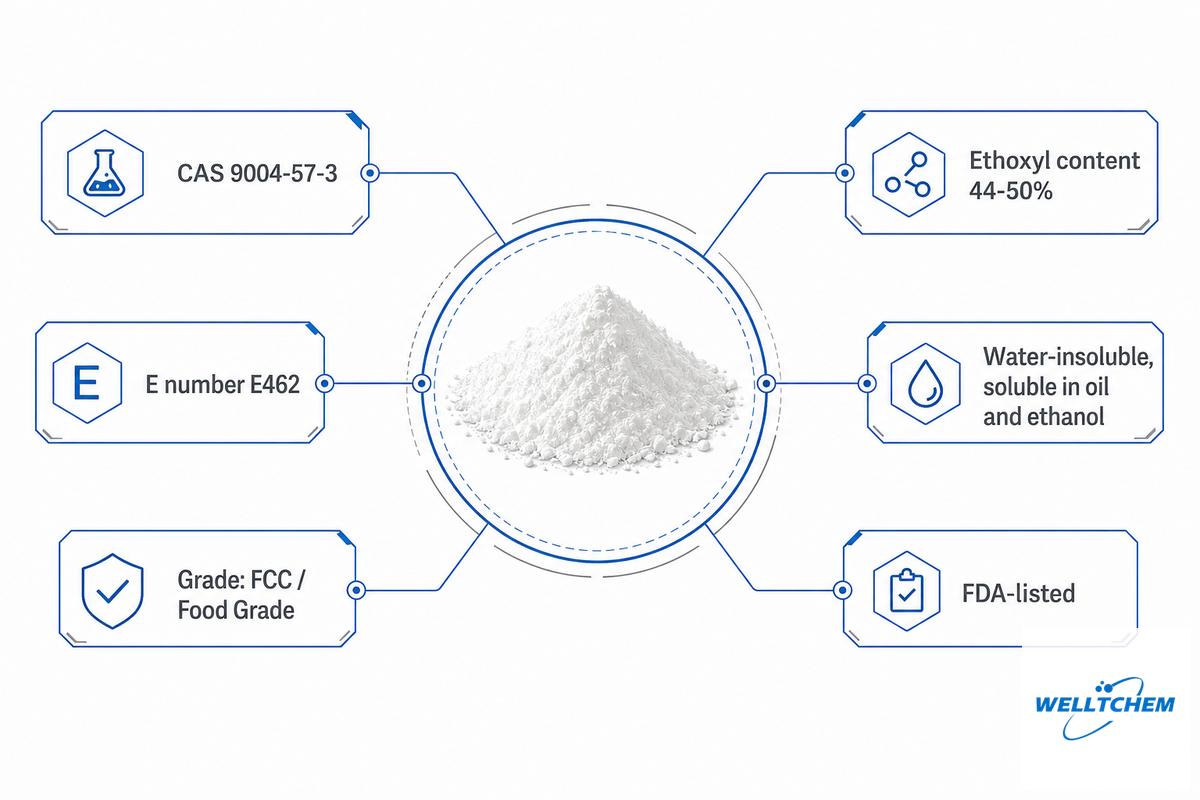
Food-grade ethyl cellulose is an FCC-compliant cellulose ether (CAS 9004-57-3, E462) made by treating wood-pulp or cotton cellulose with alkali and then reacting that alkali cellulose with ethyl chloride, a two-step manufacturing process in which a controlled number of hydroxyl groups on the raw material become ethyl ether groups.
Because it’s a derivative of cellulose, derived from cellulose, the same natural raw material behind other cellulose derivatives and cellulosics, its degree of substitution sets its behavior; food grades such as Ethocel™ sit in a defined window. To carry the food grade label, the ethoxyl content must sit between 44% and 50% on a dried basis, equivalent to no more than 2.6 ethoxyl groups per anhydroglucose unit . That spec, not the word “food” on a label, is what separates a food additive from an industrial powder. In practice, the common mistake is treating any EC powder as food-ready: because the food specification is defined by that 44–50% ethoxyl window, a grade that misses it’s a real compliance risk on a production batch, and at Wellt that’s the first thing we check before a food customer qualifies a lot.
What is ethyl cellulose (E462)?
E462 is the European food additive number for ethyl cellulose. It’s a white to off-white, odorless, tasteless powder and a thermoplastic polymer that softens with heat rather than melting cleanly. Brand names you’ll meet on a spec sheet include Ethocel and Aqualon EC, and its full physical profile is catalogued by the NIH PubChem record for ethylcellulose.
Unlike methyl cellulose or hydroxyethyl cellulose, this derivative won’t dissolve or swell in water, so it never builds viscosity in a watery system. Instead it dissolves in organic solvents and oils, forms a tough clear film when the solvent flashes off, and stays chemically inert against dilute acids, bases, and fats. Those traits explain why the same polymer show up in tablets, inks, cosmetic and personal-care films, and dinner.
Ethyl Cellulose in Food Systems: The Oil-Lock Principle
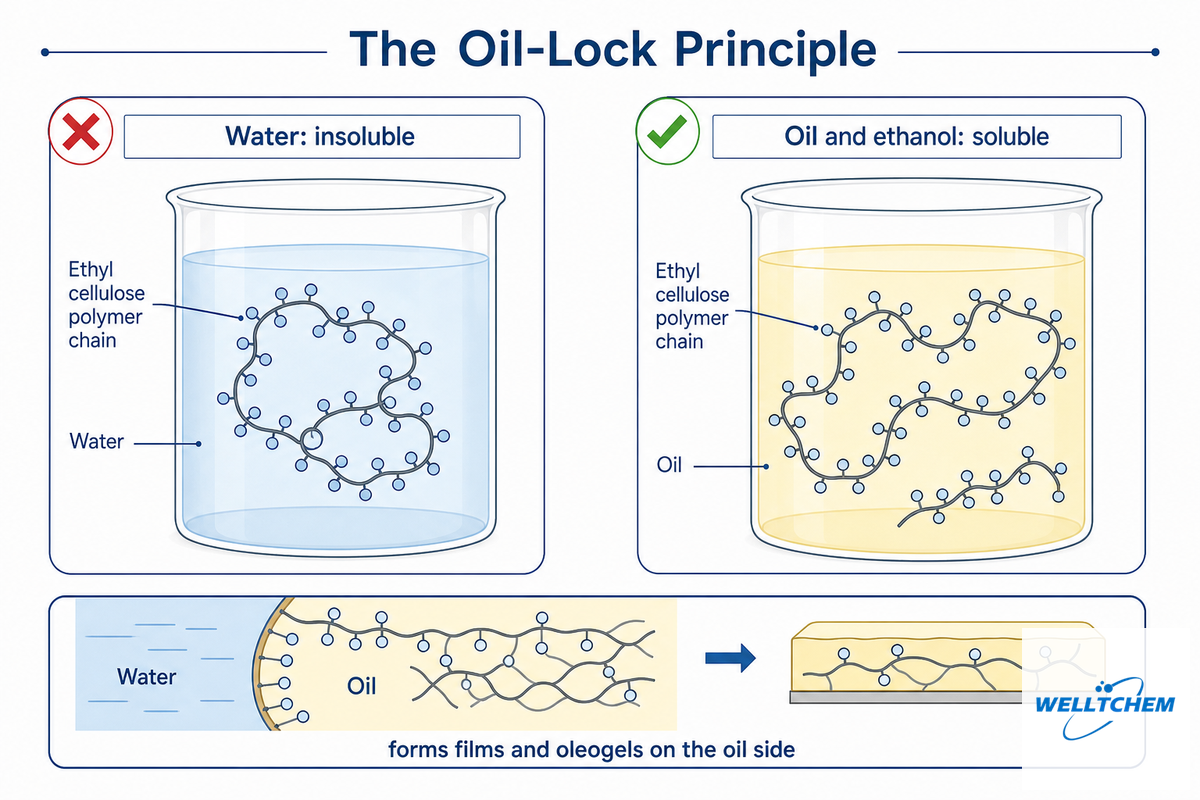
Here’s the mental model we use on the production floor, call it the Oil-Lock Principle: water won’t dissolve ethyl cellulose, but oil and ethanol will. Every food job EC does follows from that one fact. Because it ignores water, it survives on a moist surface; because it loves oil, it can gel a liquid oil from the inside. A common assumption is that all cellulose ethers thicken water, that’s wrong for EC, which the EFSA panel describes as the only modified cellulose not soluble in water . Treat it as an oil-side tool, not a water-side gum, and selection gets simple. It’s the structural opposite of water-soluble cellulosics like HPMC: where HPMC and similar cellulose derivatives act as a water thickener and emulsifier, EC is an oil-side polymer material prized for its film-forming properties, thermal stability, and adhesion rather than for thickening, working as a texture modifier and oil structurant instead.
The 9-Use Food Matrix
The same water-insoluble, oil-soluble structure powers nine distinct food jobs. We group them by function category below so you can map a need to a mechanism in one read.
| Use | Category | How EC works | Food example |
|---|---|---|---|
| Oil structuring | Oleogelator | Polymer network traps liquid oil into a gel | Saturated-fat replacement in spreads |
| Edible coating | Barrier | Water-insoluble film blocks moisture and oxygen | Cheese rind, coated nuts and fruit |
| Edible / packaging film | Barrier | Stand-alone biodegradable cast film | Biodegradable food-packaging films |
| Confectionery glaze | Coating | Dries to a hard, glossy protective shell | Candy and panned sweets |
| Flavor encapsulation | Encapsulation | Microcapsule shell protects and times release | Bake-stable flavor systems |
| Nutrient protection | Encapsulation | Insoluble wall blocks oxidation of actives | Vitamin and bioactive microcapsules |
| Tablet / supplement coating | Coating | Protective film masks taste, controls release | Vitamin and mineral tablets |
| Binder / filler | Binder | Holds dry particles together for compression | Dry vitamin preparations |
| Emulsion stabilizer | Stabilizer | Stabilizes oil-in-water systems | Salad dressings |
| Flavor fixative | Stabilizer | Retains volatile aromatics during processing | Flavor compounds |
Uses compiled from FDA 21 CFR 172.868, EFSA E462 use categories, and peer-reviewed oleogel research.
What are the uses of ethyl cellulose in food?
In food, ethyl cellulose is used for film-forming, encapsulating, binding, stabilizing, and now oil structuring. The FDA permits it in 21 CFR 172.868 as a binder and filler in dry vitamin preparations, as a component of protective coatings for vitamin and mineral tablets, and as a fixative in flavoring compounds.
The EU clears E462 as a coating agent for solid dietary supplements, a micro-encapsulating agent for colors and flavors, an emulsion stabilizer in salad dressings, and a barrier layer in pizza preparations. Because it’s non-toxic and indigestible, formulators also reach for it in functional foods, supplements, and chewing gum. Field reports from food formulators consistently put oleogels at the front of that list today.
Ethyl Cellulose Oleogels: Structuring Oil and Replacing Saturated Fat
![[REFRESH] Irgafos 168: Uses, Benefits & Specifications](https://welltchemicals.com/wp-content/uploads/2024/01/0-1.webp)
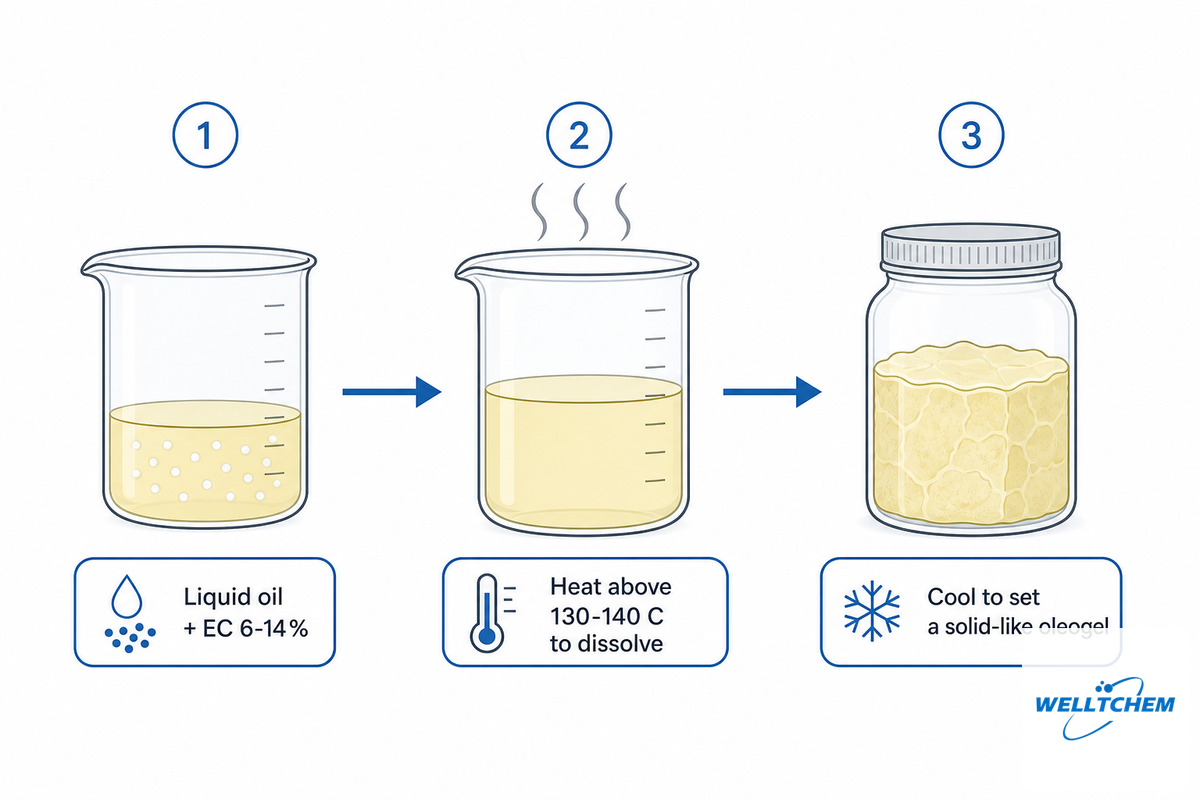
An ethyl cellulose oleogel turns liquid vegetable oil into a solid-like gel without adding water or hydrogenating the fat. You dissolve EC in the oil above its glass transition (roughly 130–140 °C), then cool the mixture; the polymer chains lock into a network that holds the oil in place. A US patent on polymer gelation of oils shows EC forms anhydrous organogels of edible oil at concentrations above 3% by weight, while peer-reviewed work puts firm, spreadable textures in the 8–14% range, with strength rising as EC molecular weight (and viscosity grade) goes up. The gel’s rheology, how it flows and yields under stress, is what makes a structured cooking oil behave like a solid fat on the palate.
This is the fastest-moving of all the ethyl cellulose food grade applications because it answers a real reformulation problem: how to cut saturated and trans fat while keeping the mouthfeel of a solid fat. Researchers have built EC oleogels from coconut, sunflower, and tucumã oils, and patents describe chocolate where an EC oleogel replaces part of the cocoa butter and structures the center filling . Reviews now position oleogels as a healthier alternative to solid fats across bakery, meat, confectionery, and dairy.
“The polymer gelator ethylcellulose may present the greatest potential for applications in a diverse range of food systems that require the unique physical properties of a structured oil.”
A. J. Gravelle, M. Davidovich-Pinhas & A. G. Marangoni, food oleogel researchers (University of Guelph / Technion)
For a firm oleogel at 10–12% EC by oil weight, weigh 100–120 g of food-grade EC per 1 kg of oil. Heat the oil to above ~130 °C with continuous stirring until the EC fully dissolves and the mix turn clear, then cool to set. Two variables decide the result: EC dosage (more = firmer) and cooling rate (slower cooling generally yields a firmer, less brittle gel). Skip the heat step and it won’t gel. Validate every batch against your own oil and target firmness.
Edible Coatings and Films for Food
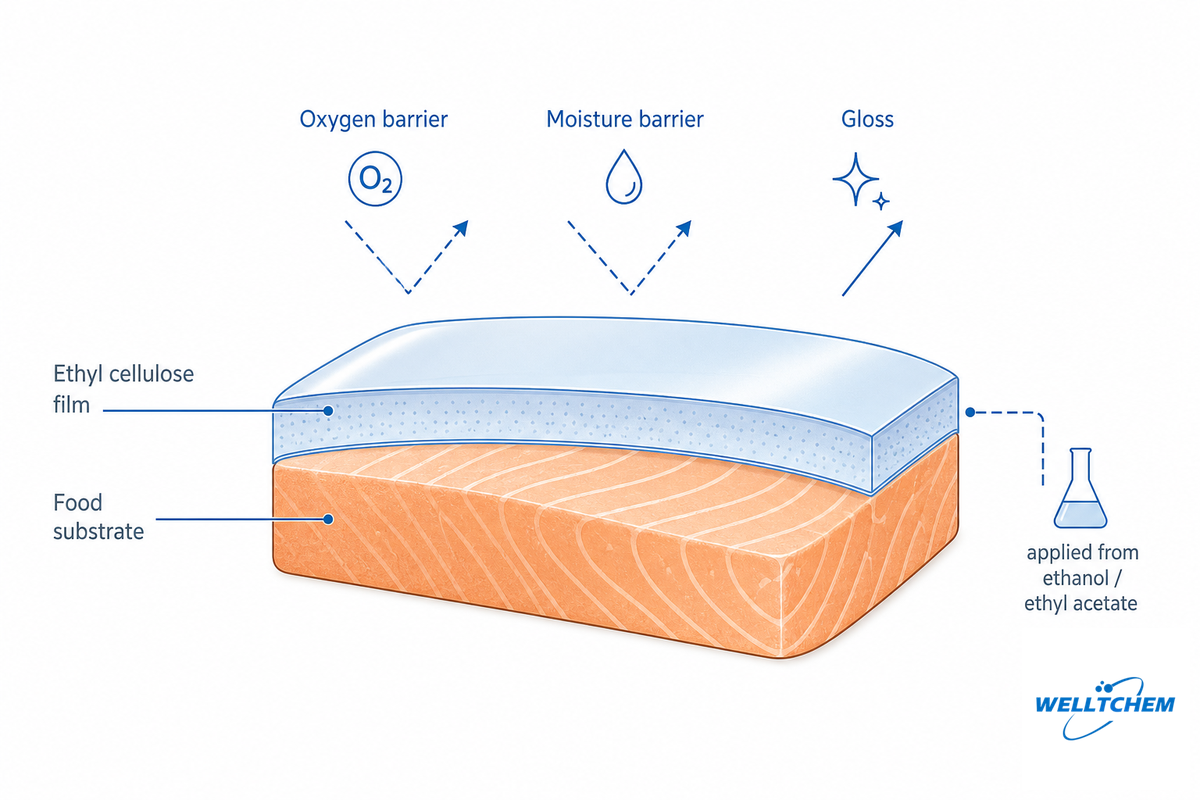
As an edible coating, ethyl cellulose is dissolved in food-grade ethanol or ethyl acetate, applied thin, and left to dry into a continuous film. Because the dry film is water-insoluble, it acts as a moisture and oxygen barrier that slows staling, oxidation, and microbial growth, cellulose coatings have been shown to extend produce shelf life by cutting moisture loss and slowing respiration . On cheese it forms a semi-permeable rind that limits drying during aging; on confectionery it adds gloss and a hard protective shell; in gluten-free bread it lends structure and moisture retention.
| Factor | Ethyl cellulose | Carnauba / bee wax | Shellac |
|---|---|---|---|
| Moisture barrier | High (water-insoluble film) | High | Medium-high |
| Gloss / hardness | High, tough and clear | Soft, satin | Very high gloss |
| Carrier solvent | Ethanol / ethyl acetate | Hot melt | Ethanol |
| Vegan | Yes (plant-derived) | Carnauba yes / bee no | No (insect-derived) |
Comparison reflects general coating behavior; confirm against your spec and target food.
The practical challenge here’s moisture: a cheese that dry out or a fruit that respires too fast loses saleable weight on the line, and because the EC film is water-insoluble it slows that loss in real production where wax alone falls short. Beyond food, the same film chemistry serves printing inks and hot-melt molding, and EC’s biodegradability makes it a high-performance candidate for greener packaging. The same film-forming and moisture-barrier behavior pushes EC into biodegradable food-packaging films, an active research area at university labs studying EC-based polymeric films for packaging . For other coating chemistries, our guide to coating additives covers wetting and defoaming partners such as Surfynol 104 and BYK-349.
Flavor, Oil and Bioactive Encapsulation (Controlled Release)
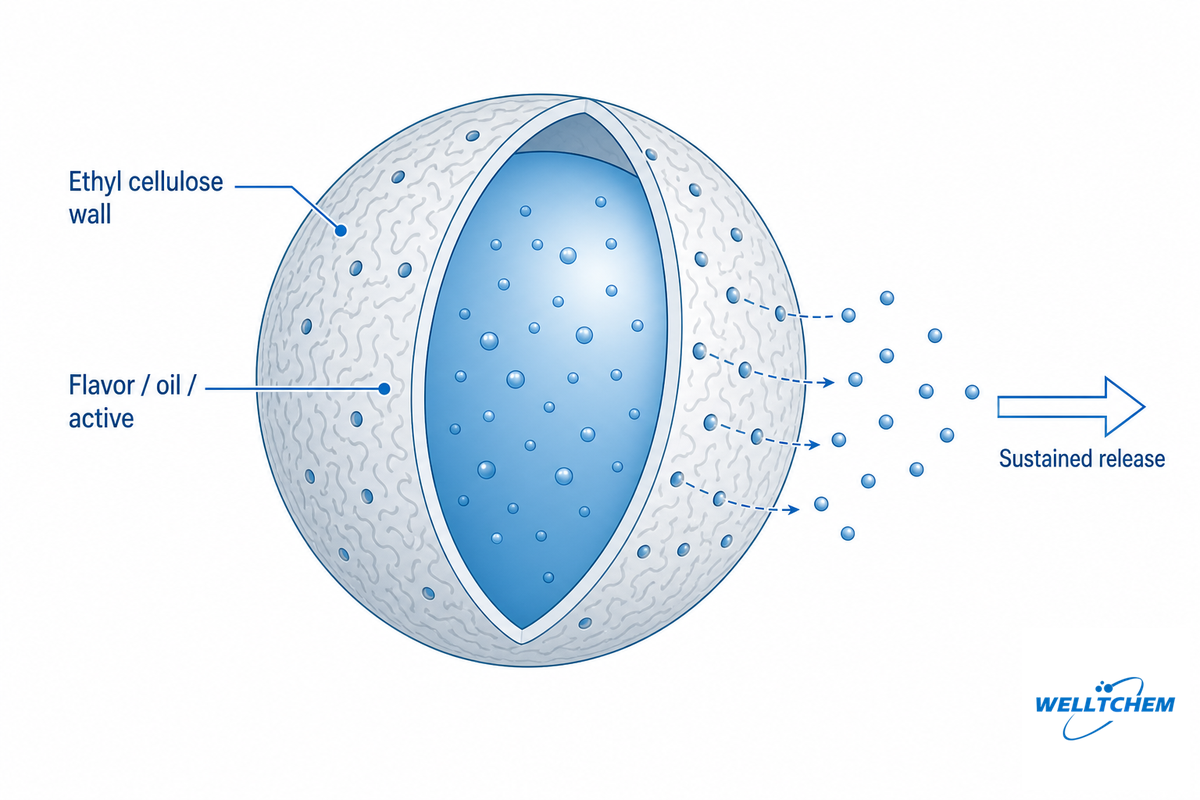
Encapsulation is where the insoluble shell earns its keep. Dissolved EC is used to build microcapsules, by spray drying or solvent evaporation, around volatile flavors, oils, and oxidation-sensitive actives such as vitamins. The water-insoluble wall protect the payload during processing and storage, then releases it slowly during use or digestion. This is the same controlled-release mechanism EC provides in pharmaceutical modified-release dosage and drug delivery, sustained-release tablets and granules where the film doesn’t swell and slows release in contact with water. The same micro-encapsulation principle protects a fish-oil or cooking-oil payload in a food matrix. These EC delivery systems are widely used in pharmaceuticals too, from sustained drug release in pharmaceutical formulations to novel drug delivery matrices, which is why food formulators trust the mechanism. In food, that translates to flavor fixatives that survive baking and nutrient systems that don’t oxidize on the shelf.
The problem encapsulation solves is concrete: in production, an unprotected citrus flavor or omega-3 oil can oxidize and fail a shelf-life test, so the insoluble EC wall is what keeps the payload intact because water and air can’t reach it. Because the polymer is inert and tasteless, it adds no flavor of its own, an important point for delicate seasoning and beverage systems. EC encapsulation sits alongside other food-grade protection chemistries; for oxidation control specifically, compare it with a food antioxidant such as food-grade TBHQ, and see our overview of types of food additives.
Choosing the Right Food-Grade EC Grade (Viscosity and Solvent)
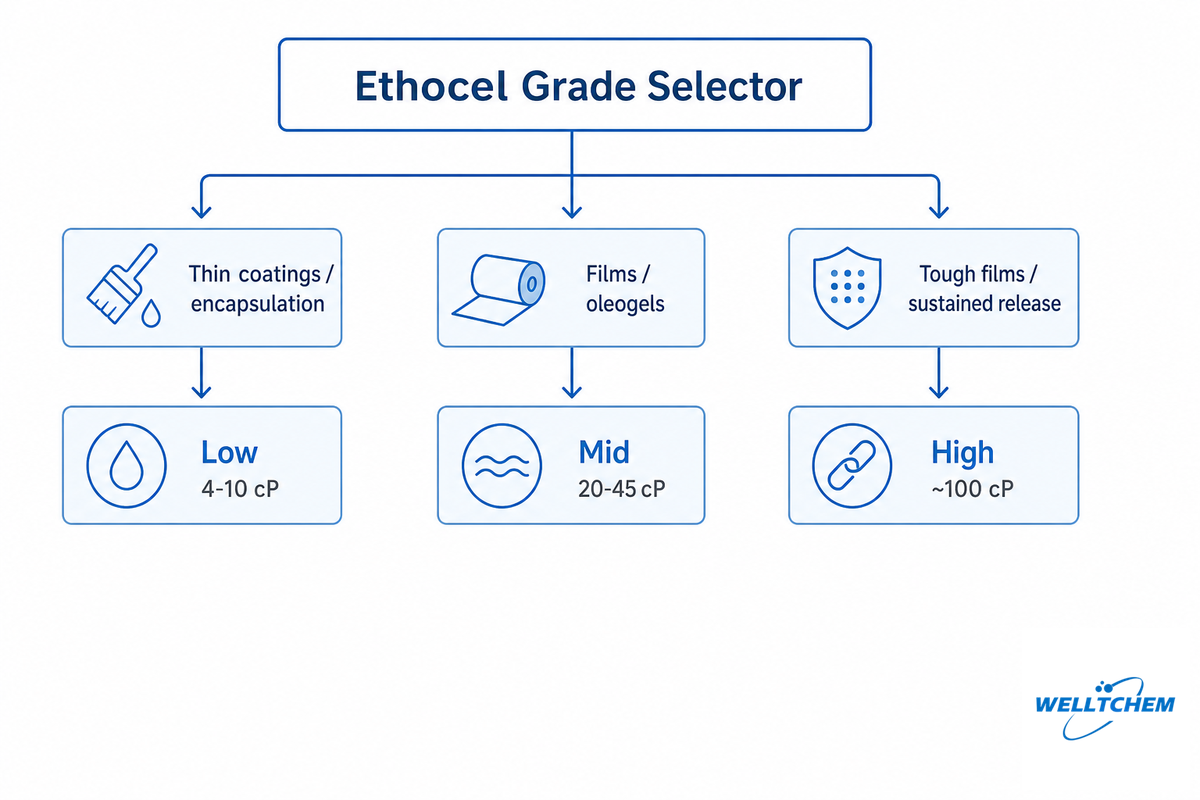
Grades differ mainly by viscosity, measured as a 5% solution. Food and feed grades typically span 4–100 mPa·s, while pharma stretches to 300 . Beyond viscosity, a typical food grade shows bulk density 0.35–0.50 g/cm³, moisture ≤3%, ash ≤0.5%, a melting range near 240–255 °C, and roughly a 36-month shelf life. Low-viscosity grades give thin, fast-drying films and disperse easily for encapsulation; high-viscosity grades give tougher films and slower release. Picking the wrong viscosity band is the most common and expensive selection mistake, because a grade tuned for thin coatings will never set a firm oleogel; the Wellt technical team typically asks for target film thickness and release rate before recommending a band. Use this as a starting decision tree, then trial against your own formula.
| If your application is… | Choose viscosity band | Why |
|---|---|---|
| Thin coating / flavor encapsulation | Low (~4–10 mPa·s) | Sprays and atomizes easily; thin uniform film |
| Edible film / oleogel | Mid (~20–45 mPa·s) | Balanced strength and flexibility; good gel firmness |
| Tough film / slow sustained release | High (~100 mPa·s) | Strongest, most durable film; slowest release |
Bands are directional starting points; verify with your oil, solvent, and process.
On solvents, keep it food-safe: ethanol and ethyl acetate are the workhorses for food and feed work. Solvents such as toluene, chloroform, methanol, methyl acetate, and tetrahydrofuran appear in technical data but aren’t appropriate carriers for food. Ethoxyl content also shifts solubility, grades near or above 46–48% dissolve freely in ethanol, which is what you want for edible systems; the NIH PubChem solubility data is a useful cross-check when matching a grade to a solvent.
Is Food-Grade Ethyl Cellulose Safe? (E462, FDA, EFSA)
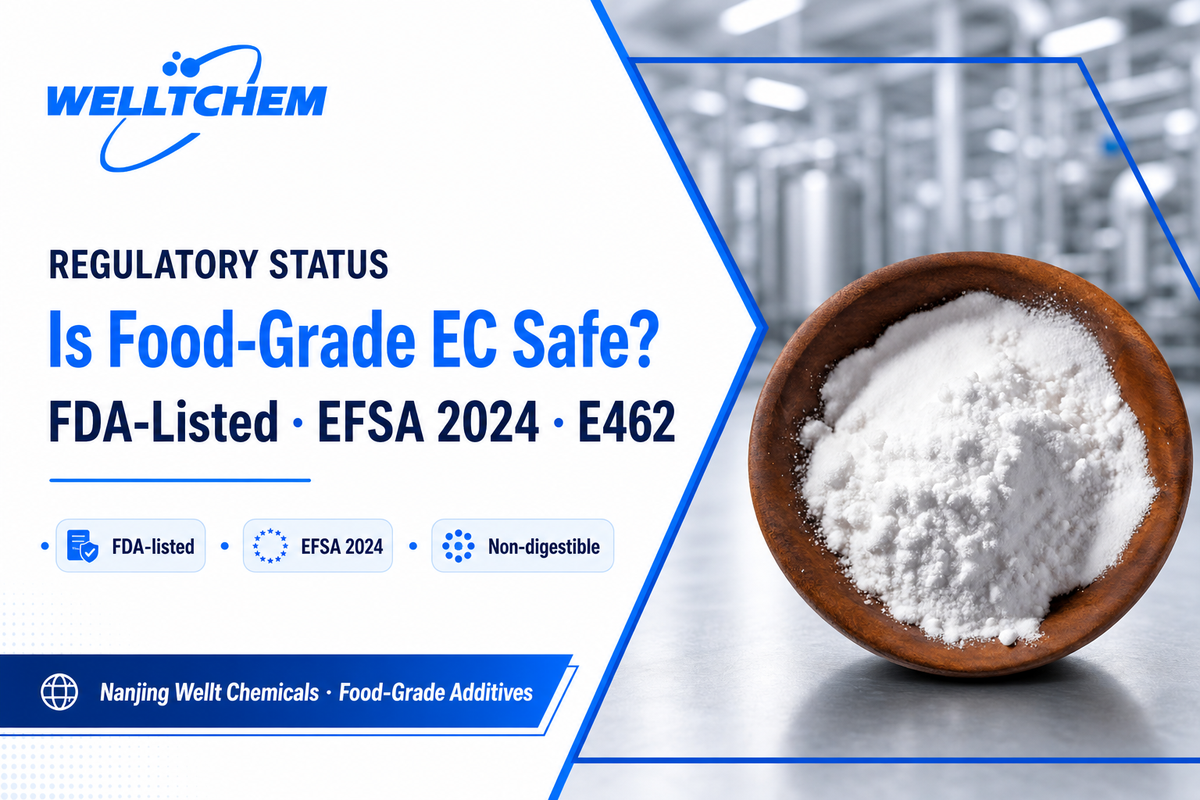
Food-grade ethyl cellulose is recognized as safe by every major authority. The FDA lists it under Substances Added to Food and clears specific uses in 21 CFR 172.868, the EU authorizes E462, and JECFA set an ADI of “not specified.”

EFSA’s 2018 re-evaluation found low acute oral toxicity, no adverse effects, and concluded that no numerical Acceptable Daily Intake is needed. Its non-toxicity is well documented, and possible side effects are minimal because it isn’t absorbed, which is exactly why it’s so widely used in food.
Is ethyl cellulose safe to eat?
Food-grade ethyl cellulose is safe to eat and, just as important, inert: it isn’t digested or absorbed but passes through the body unchanged, which is why regulators see little toxicological concern. EFSA’s 2018 opinion even permits use in foods for infants and young children within set levels.
A fresh 2024 EFSA opinion judged the EC feed additive safe for all animal species, consumers, and the environment . The polymer is synthetic rather than naturally occurring, but it’s generally recognized as halal, kosher, gluten-free, and vegan because it’s plant-derived and made without animal inputs. The practical caution is sourcing, not safety: only powder that actually meet the FCC food specification and is made under cGMP should go into food. In practice the failure mode isn’t toxicity but procurement, a buyer who skips the FCC certificate risks an industrial grade slipping into a food line, which is exactly the audit gap we see at Wellt when customers switch suppliers to chase a lower price.
Food grade is not a marketing word — it is a specification. An industrial EC powder may share the same CAS number yet fail the ethoxyl, residual-solvent, or heavy-metal limits required for food. Always buy against the FCC E462 monograph, not the product name.
Sourcing Food-Grade Ethyl Cellulose: What to Verify
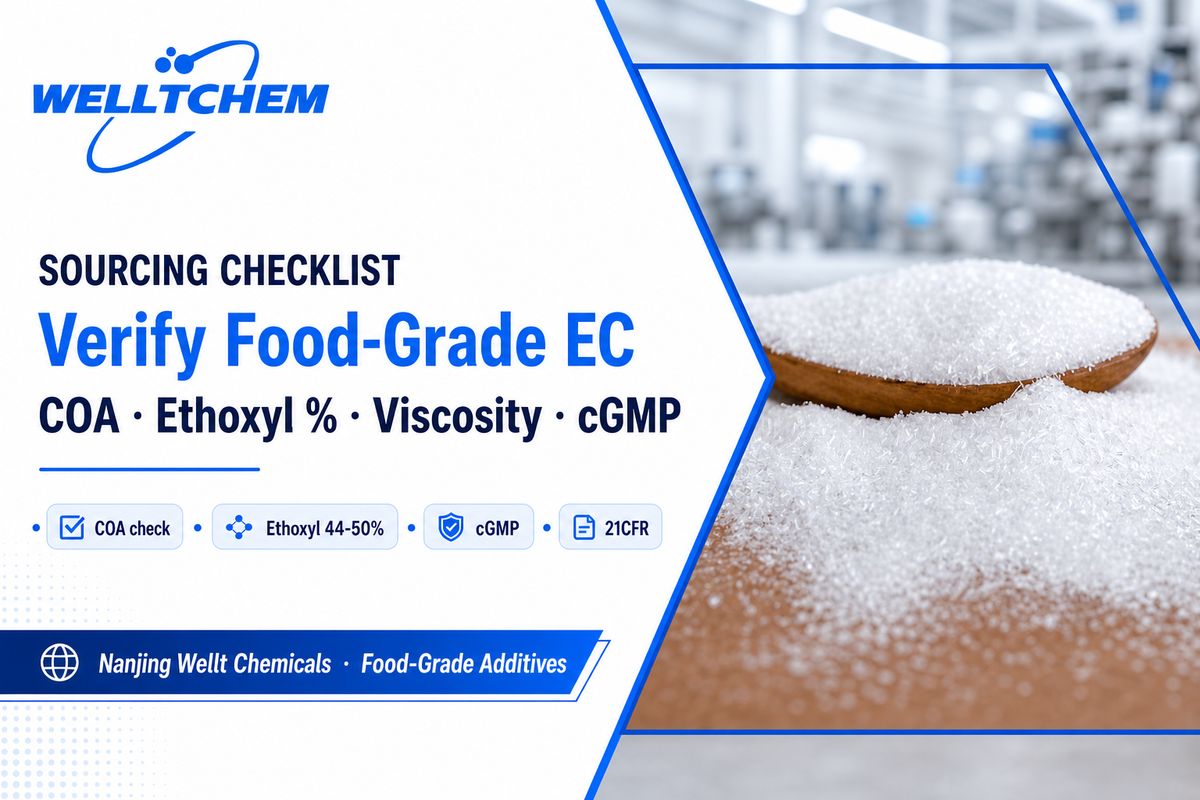
When we ship food-grade EC, buyers who avoid problems all check the same things on the certificate of analysis before the first trial. Use this as the Food-Grade EC Spec Checklist.
- ✔ FCC / E462 compliance statement (plus USP/EP/JP if you export)
- ✔ Ethoxyl content reported and within 44–50%
- ✔ Viscosity grade stated (e.g., 10, 20, 45, 100 mPa·s) so it matches your application
- ✔ Residual solvent and heavy-metal limits within food specification
- ✔ cGMP / 21 CFR manufacturing and food-safe packaging declaration
If any line is missing, ask for it in writing before ordering. You can review our food and coating grade on the food-grade ethyl cellulose product page, and see how we present specs across additives like AMP-95 coating additive. For broader context on additive categories, our post on common food additives is a useful primer.
Where Food-Grade EC Is Headed: Fat Reformulation and Sustainable Packaging
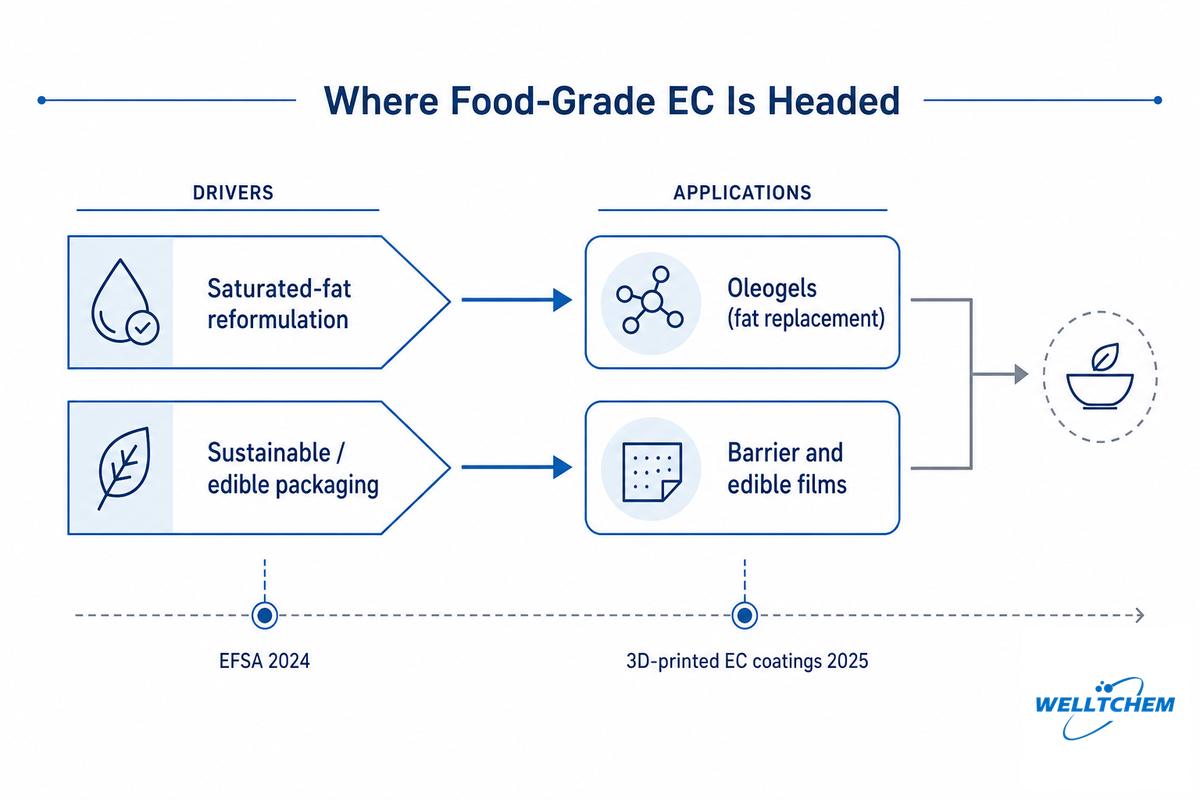
Two demand drivers are pulling food-grade EC forward, and neither is a market chart. The first is fat reformulation: pressure to cut saturated and trans fat keeps oleogels in active development as a way to deliver solid-fat texture from liquid oil, which is exactly what EC does best. The second is sustainable packaging: as brands move off conventional plastics, biodegradable EC films and active edible coatings, including work on 3D-printed and hot-melt-extruded EC coatings reported in 2025 become commercially interesting.
For buyers, the action item is concrete: 2024 was an active regulatory year (a new FDA Federal Register rule plus a fresh EFSA opinion), which confirms EC’s food and feed status is current rather than legacy. The risk for a brand is being caught flat-footed: if a reformulation project needs a food-grade oleogel and no qualified EC supply exists, the launch slips while procurement scrambles. If oleogels or edible films are on your roadmap, qualify a verified FCC-grade EC supply now so reformulation is not blocked later. For context, the edible films and coatings market is often cited around USD 2.6 billion in 2025 with high-single-digit growth, though figures vary by scope and should be treated as directional background .
Frequently Asked Questions
Q: Is food-grade ethyl cellulose safe to eat?
View Answer
Q: What is the difference between food-grade and standard ethyl cellulose?
View Answer
Q: What are the main food applications of ethyl cellulose?
View Answer
Q: Does ethyl cellulose dissolve in water?
View Answer
Q: What is E462?
View Answer
Q: Which Ethocel grade is best for oleogels?
View Answer
Q: Is ethyl cellulose vegan and gluten-free?
View Answer
Yes, in almost every case. Ethyl cellulose is derived from plant cellulose such as wood pulp or cotton and is manufactured without animal-origin materials, so it qualifies as vegan. Because it contains no wheat, rye, or barley, it is also treated as gluten-free under FDA criteria, and most food grades are additionally certified halal and kosher pareve for broad dietary compliance.
Request a specification sheet and a sample to trial against your formula, or ask our team which viscosity grade fits your application.
View Food-Grade Ethyl Cellulose →
Request a Sample / Spec Sheet
About This Analysis
As a manufacturer and supplier of food and coating additives, we wrote this to separate genuine food-grade ethyl cellulose use from generic “uses of EC” content. The oleogel dosing range, viscosity decision tree, and FCC spec checklist reflect how we help customers qualify EC for food; regulatory and oleogel figures are cited from FDA, EFSA, JECFA, and peer-reviewed sources rather than our own lab. Reviewed by the Nanjing Wellt Chemicals technical team.
References & Sources
- 21 CFR 172.868, Ethyl celluloseU.S. Food and Drug Administration
- Food Additives Permitted in Feed and Drinking Water of Animals; Ethyl Cellulose (2024)FDA, Federal Register
- Re-evaluation of celluloses including E 462 (2018)European Food Safety Authority
- Safety of a feed additive consisting of ethyl cellulose (2024)European Food Safety Authority
- Biopolymer coatings for edible fruits to extend shelf lifeNIH / PMC
- US20120183663A1, Polymer gelation of oilsUSPTO via Google Patents
- Mechanical properties of ethylcellulose oleogelsPubMed / NIH
Related Articles
- Ethyl Cellulose: A Complete Guidechemistry and industrial uses
- The Ultimate Guide to Coating Additiveswhere EC fits among coating chemistries
- Food Additivescategories and functions